Play Recent

Slipping Away

Coded Dreams, 9 October 2024 – 12 January 2025, Centre PHI

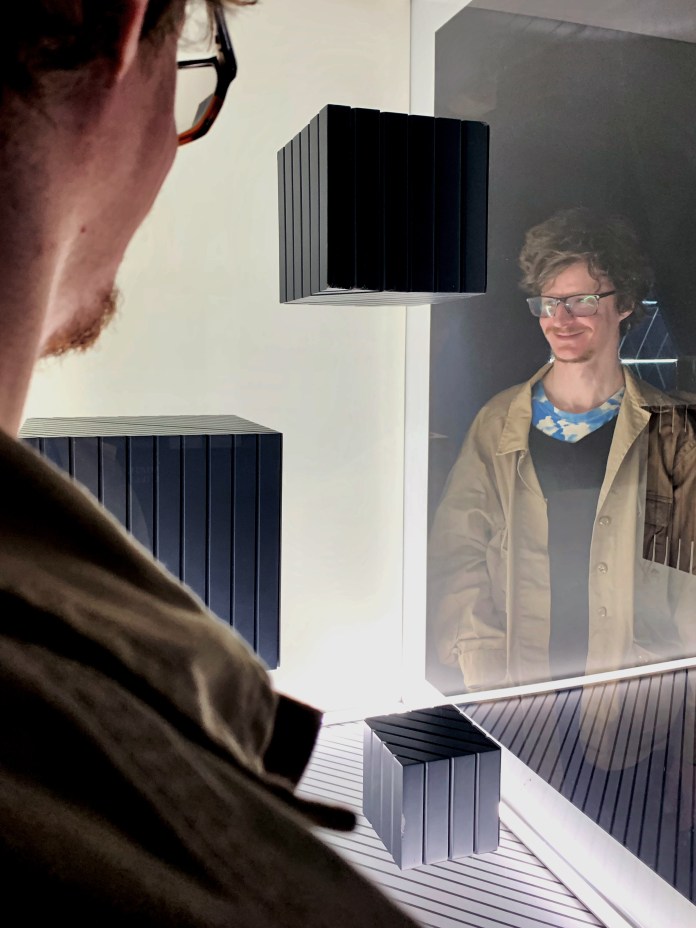
Marc Da Costa and Matthew Niederhauser at Centre PHI. Photographed for NicheMTL.

“First the sun and then the moon, one of them will be ‘round soon.” —The Rolling Stones, “Slipping Away”

The impetus for technological innovation was once upon a time to extend humankind’s functional capacities. We invented shovels so we wouldn’t have to dig with our fingers. We devised washing machines so we wouldn’t have to scrub our fabrics by hand. Books prolonged our natural memories; recordings preserved ephemeral sounds that would have otherwise been lost in time.

Media then became all about compression, packing more and more into less and less. Books and motion pictures and audio recordings were progressively condensed onto celluloid reels, shellac disks, vinyl records, magnetic tape, then digitized into formats that advertised their increasing miniaturization. The Compact Disc. The iPod Nano. The MacBook Air. Everything into nothing.

Artificial Intelligence presents the veneer of infinite information beneath a shiny, tiny interface. But below the surface, it’s as hollow as an abandoned snail shell — pretty but vacant.

“Images and information,” writes the media theorist Laura Marks in her 2010 book Enfoldment and Infinity, “come into the world and roll back into the infinite in a ceaseless flow of unfolding and enfolding.”

It is not, however, the process of unfolding-enfolding that is ceaseless; it’s the flow.

Communauté Slo / Nancy Tobin, Superheart L’Opera, 9 October 2024, La Chapelle | Scènes Contemporaines

The company of Superheart L’Opera receives a standing ovation. Photographed for NicheMTL.

“The future exists only in the shape of our present apprehensions and hopes, and the past merely as memory.” —W.G. Sebald, The Rings of Saturn

The camera eye is a consumer-grade drone flown across the New Mexico desert by a twelve-year-old boy named Emmanuel. We cruise smoothly over scrub and brush, whizzing above rocks and low bushes, surrounded by nothing but reddish-brown sand and cerulean, blue sky. In the far distance, mountains; in the other direction, what looks like a state-of-the-art military base.

A hare scurries among the spikey cacti and thistle weed, approaching the observation tower and barbed wire fences surrounding the secured compound. As it tracks the hare, Emmanuel’s drone suddenly explodes mid-air, apparently shot by an automated ballistic weapon.

The boy runs to the perimeter fence, tears streaming down his face. He retrieves the wreckage as an obese, moustached guard wearing a bulletproof vest and aviator sunglasses approaches the fence from the other side.

“Shouldn’t be flying that damn thing around here, kid,” warns the guard — too late for Emmanuel.

“This base has the highest-level security of any in these United States,” he mutters to no one in particular as he wheels back on his leather boots and returns like a fat robot to his post.

A Place to Noise, Léa Boudreau, 11 October 2024, Cyber Love Hotel

Schematics drawing at Léa Boudreau’s A Place to Noise installation. Photographed for NicheMTL.

“Nothing here now but the recordings.” —William S. Burroughs, “Soul Killer”

Autumn is undoubtedly the season for nostalgia, for reflecting on the year’s events and making plans for whatever time is left. The falling leaves signify time’s passage and the inevitability of death. Montreal’s autumnal magnificence is surely a testament to the truth that there is beauty in decay, that youth is illusory, time is cyclical.

Sometimes, you already know when something is happening that you will become nostalgic for that time later in life. It’s an uncanny feeling, projecting yourself into an inherently sadder future in which you will miss the moment you’re inhabiting right now. The now that will be.

When you have that future nostalgic sense, hold onto it for as long as possible, and then let it go as soon as you feel its departure.

Cleave it and leave it.

Wadada Leo Smith and Sylvie Courvoisier with Rehab Hazgui, 7 October 2024, La Sala Rossa

Rehab Hazgui performs at La Sala Rossa for the Flux Festival, 7 October 2024. Photographed for NicheMTL.

“In conditions of digital recall, loss is itself lost.” —Mark Fisher, Ghosts of My Life

Human memory has always been selective. We tend to recall our favourite moments with crystal clarity. Trauma, too, marks our commemorative impulses deeply. But hard drives and digital memory store the good and the bad with ruthless indifference. They can call up any memory at any given time — even simultaneously — with the happiest and most distressing events sitting right next to each other, sharing virtual space on a plane with seemingly an infinite amount of it.

Machines don’t discern between one or another emotion. Plenty of sweat and tears have been shed trying to teach them to behave more human-like. The question is, should machines become more like us, or should we strive to be more like them, abandoning our warm and soft physicality for something colder and more calculating?

FYEAR with Erika Angell, 16 October 2024, Centre PHI

Left: Tawhida Tanya Evanson; Right: Jason Sharp of FYEAR. Photographed for NicheMTL.

“What’s done in the dark will be brought to the light.” —Johnny Cash, “God’s Gonna Cut You Down”

I received an email from a friend recently telling me that he was finding it increasingly difficult to do anything “for fun.”

The news of war in Lebanon — and Gaza, and Ukraine, and Sudan — was apparently robbing him of the inner capacity for enjoyment just for the sake of enjoyment. Of course, we focus on death toll and count victims in numbers. But enlightenment is immeasurable, and the true casualty of war.

This, I believe, is what Mark Fisher meant by “consciousness deflation.” In order to raise the awareness of our collective situation and surroundings, we require an elevated sense of perspective. We have to become lighter to attain the moral high ground. Our opponents seek to lower us, to weigh us down with a constant barrage of base-level emotions — fear, anger, hatred — that enshroud us in a thick and heavy darkness.

In Krakow’s ghetto district, where thousands of Europe’s Jews were rounded up during World War II before being shipped off to die in concentration camps, I was surprised when I travelled there for the first time in 2018 to see a graffito on a tenement wall depicting Gene Kelly from the 1952 film Singin’ in the Rain with a caption reading, “I’m happy again.” A dark joke, I thought.

I couldn’t help but laugh, though, given the context — both historical and geographical.◼︎

Thank you for inviting NicheMTL to your thing. Please get in touch at the about page.

NicheMTL is Montreal’s independent not-for-profit source for this city’s most niche arts and culture. If you love what you’re reading, please consider subscribing.

Cover image: Still from Marc Da Costa and Matthew Niederhauser’s The Golden Key. Photographed for NicheMTL.

Standard
How Do You Spell Holiday?

Questions In a World of Blue: in conversation with WE ARE WINTER’S BLUE AND RADIANT CHILDREN

Desperation is the raw material of drastic change. —William S. Burroughs, “Soul Killer”

Turning power against itself has always been a useful form of resistance.

Donning the enemy’s flag and uniform has historically been deployed as a consistently successful strategy to confuse and infiltrate any opposing army. American Delta blues artists like Skip James and Robert Johnson confronted the misery of the Great Depression by singing sad songs. The legendary Montreal post-rock record label Constellation in the early days of the corporate internet posted to its website a manifesto proclaiming, “THE WORLD HAS NOT CHANGED. THE WORLD REMAINS THE SAME. THE END OF THE WORLD WILL NEVER COME. WE ARE ALL GUILTY.”

It is befitting, then, that more than two decades later, Patch One, the Portland, Maine-based artist and musician, the experimental guitarist and synth player Jonathan Downs, Efrim Manuel Menuck, a founder member of Godspeed You! Black Emperor and numerous offshoot bands, and I meet via Zoom, the technology platform that came to fame most notably during the coronavirus crisis, to discuss their latest collaboration, a battle-weary go-screw-yourself forthcoming on Constellation Records, squarely aimed at state power, entitled NO MORE APOCALYPSE FATHER.

“Fuck this app,” Menuck ceremoniously exclaims from behind a mountain of beard and hair as he flickers onscreen.

The four of us are gathered virtually on the day that the last remaining North American university campus protest against Israel’s bombardment of Gaza, at McGill, is bulldozed. It’s a stark local coincidence that underscores the simultaneous urgency and ambience of apocalyptic global events, as well as the necessity for artists to continue making art in the face of it all.

“I think ‘contribution’ is a key word,” says Patch in response to the question of how music can stimulate social change. “I can pretty quickly talk myself into a corner and think that this is nothing, this is fucking stupid that I’m doing this right now. But I don’t actually believe that. That’s what the powers that be are telling me to think. There is a lot to be said for putting things out into the world.”

WE ARE WINTER’S BLUE AND RADIANT CHILDREN sleeve drawing. Patch One.

“For me, making stuff is a compulsion,” Menuck insists. “As far as I can tell, the responsibility of an artist is to address whatever reality they’re living in in the moment in a way that’s truthful. And there are a bunch of different truths. I think the four of us in the band share certain types of truth that lead to the record that we made.”

NO MORE APOCALYPSE FATHER clearly originates from a post-punk infused worldview, and a post-rock inspired aesthetic: shimmering, lurching, distorted dirges that harken to Thee Silver Mt. Zion Memorial Orchestra’s catalogue, as well as that of Big|Brave guitarist and collaborator Mathieu Ball, with whom I caught up a few weeks later at a gig at Ateliers Belleville.

“I don’t know how this album came together,” Ball admits. “It just did.”

Although Patch and Downs are American, Montreal’s zeitgeist comes to the fore with WE ARE WINTER’S BLUE AND RADIANT CHILDREN.

“Like every bigger city in the world,” observes Ball, “with the cost of living continuously increasing, I do find it slightly harder to continue pursuing creative endeavours. It’s becoming more difficult to find a studio and workspace. But the creative community in this city will not anytime soon cease to exist.”

The album was recorded over an intense week with the foursome hunkered down at Hotel2Tango, the studio which incubated some of Montreal’s most enduring recordings, including Fly Pan Am’s N’écoutez pas, Arcade Fire’s Funeral, and Godspeed You! Black Emperor’s debut, F♯ A♯ ∞.

“Patch and I drove up to Montreal at the end of last August,” Downs recalls. “Efrim knew how we played and asked us to be a part of it. He thought we’d fit in. He and Mathieu had worked out some jams beforehand, and Efrim had sent us all some skeletal structures — some ‘songs,’ you might say. It was all kind of loose and we listened to the songs over the PA speakers and just put more into them and built them up.”

That layered approach produced an encrusted and profoundly moving LP that primarily invokes the despair of observing savagery from a safe distance whilst being unable to intervene. This theme is ever-present, even metaphorically, for instance, on the song entitled “Dangling Blanket from A Balcony (White Phosphorous)” which grapples with the shock of watching Michael Jackson suspend his son out of a hotel window for the apparent bemusement of the paparazzi.

“I think that sometimes people make the mistake of thinking that having empathy or feeling pain watching something happen is a productive human value,” says Menuck. “It’s a reflex, and it’s a good reflex. But the reality is that it doesn’t do anything on its own.”

“Not that there’s not always horror and war in the news,” Patch chimes in, “but since we recorded this, I’ve thought a lot about how people use social media and post things on the internet. Everyone that I look at on the internet is just showing me all this shit and it’s like, what does this mean for the people? Are you trying to do this just to show me something about what’s happening, or to show me something about yourself? I don’t blame people because it is a thing, and I’ve been that person, too. You want to feel like you’re fucking doing something while you’re just sitting there at home or whatever.”

“The big problem,” adds Menuck, “is that the way to disseminate these images is all owned by huge sketchy companies that are really just data-scraping endeavours. Who owns these companies? I feel like there has been stuff on social media that’s made a change. But what that change leads to, I don’t know. What people do with that horrible feeling of being stuck just witnessing is what matters. Just the witnessing doesn’t matter.”

WE ARE WINTER’S BLUE AND RADIANT CHILDREN back cover photo. Efrim Manuel Menuck.

“I wonder,” muses Downs “what other moments in history would have been like with everyone having a smartphone, or a camera, and being able to connect information from those devices to a lot of people? I think it has made more people aware with a lot more people looking at it. The more people tear away from the mainline story of what’s happening, the better.”

The media landscape within which WE ARE WINTER’S BLUE AND RADIANT CHILDREN emerged, however, is unique, even in a world that seems to interminably reiterate atrocity. There are now multiple wars raging, with no end in sight, and a panoply of viewpoints on every aspect of daily life. There is no question that art contributes to producing more positive conditions, if even to offer a soothing tune in troubled times. But how that occurs is difficult to describe.

“I think a melody with words attached that have some sort of meaning does get into people’s heads” Menuck explains. “But at the same time, we’re not making popular music. So, it’s just a few people at a time.”

Now Menuck starts second-guessing himself.

“If one song changes…” he pauses mid-thought. “No, if one song opens someone’s mind… No, that’s way too heavy. If one song gets a certain idea… No, that’s heavy, too.

He exhales a plume of smoke and reorients himself in front of the camera eye.

“Mostly the world is going to change based on small things like the conversation we’re having with each other. That stuff does ripple out. It’s not enough. It’s really not enough. But it does play a part. We live in an organic system, and all these small things interweave with each other. And all these tiny little accidents are what make change at the end of the day. It’s not a glorious thing or a heroic thing. It’s just trying to contribute to something that’s better than this.”◼︎

NO MORE APOCALYPSE FATHER is released via Constellation Records 13 September 2024.

Standard
All Dressed

Fear & Desire: in conversation with Kaie Kellough & Jason Sharp

For an awkward second, silence rings out on the FaceTime line.

I have just asked saxophonist Jason Sharp and poet Kaie Kellough, who dually lead the experimental Avant-jazz nonet, FYEAR, how their band’s name is supposed to be pronounced. Kellough turns the question back on me. “How would you pronounce it?”

Already, I feel as though I’m being tested. I tell the pair on the other side of the screen that I’d say: “F-Year” — as in, the year following A, B, C, D, and E.

“It could work that way,” says Kellough, “if it makes you more comfortable.” Knowing little of comfort, I persist with the enquiry.

“I’ve been saying straight-up ‘fear,’” Sharp informs, “the emotional state.”

“I’ve been emphasizing the ‘Y,’” says Kellough with a smirk. “There’s an extra vowel in there: Fyyyear,” he stretches out the syllable into two.

“It was coined during the pandemic, during the lockdowns. And basically, it comes from a very simple observation — that it was a fucked-up year. Hopefully it causes a little bit of uncertainty.”

FYEAR, from left: Jesse Zubot, Kevin Yuen Kit Lo, Kaie Kellough, Jason Sharp, Joe Grass, Josh Zubot, Tawhida Tanya Evanson, Stefan Schneider, Tommy Crane. Frank Schemmann for Constellation Records.

Doubtless, nothing else in 2024 sounds quite like FYEAR’s self-titled debut recording. Generically, it’s an adroit and ambidextrous mix of improvisatory free jazz, chamber music, spoken word, electronic, and Afrobeat. The instrumentation of two percussionists, two violinists, two poets, a pedal steel guitar, and Sharp’s bass and baritone sax combine for a collaborative album as delightful as it is daring.

“This particular project has a lot of nods to a lot of different traditions,” Sharp tells me. “As a performer inside of it, I feel like it travels. It’s most enjoyable that way.”

FYEAR’s mission grew out of a partnership between Sharp and Kellough that began just as the Coronavirus crisis hit in 2020.

“About a year beforehand,” Sharp says, “we performed a version that was not quite fully composed and included fewer members, opening for Saul Williams at La Sala Rossa. That was the first iteration that had more of the defining seeds. Certainly, the vocabulary has been brewing for many years. But it finally catalyzed during Covid.”

FYEAR, “Pt II Mercury Looms (excerpt)”

Although FYEAR is technically Montreal-based, the three of us share a moment when we collectively realize that we all hail originally from Alberta — Kellough from Calgary, and Sharp and I from Edmonton.

During his teenage years, Sharp got a taste for the stage playing baritone saxophone in The Little Birds Big Band, a youth ensemble that performed regularly at the Yardbird Suite, Edmonton’s legendary jazz club.

“I remember around that time I went to see Steve Lacy play solo at the Yardbird,” Sharp recalls. “That was my first encounter with a more improvisational performance. Steve is such an influential musician. He seemed to span this world of classical music and jazz and improvisation. And he played this solo soprano saxophone concert, and I was riveted. It definitely left a mark on me.”

“It’s like getting that snowball that you’ve been pushing to lurch forward and roll on its own.” Pierre Langlois for Constellation Records.

Kellough discovered a fondness for the rhythms of language after reading the Harlem Renaissance poets Countee Cullen and Langston Hughes in high school English classes.

“It was poetry that referenced a musical tradition but also spoke about people’s everyday experiences,” Kellough explains. “Even if I’m a writer who writes very differently from Countee Cullen or Langston Hughes, I find that those were two writers who drew me into poetry, initially, and made me feel like it was something that was relevant in the world. Certainly, something that was relevant to me. Something that I might think of doing.”

Often, the metropolis that draws westerners is Vancouver; yet migrating east to Montreal was a notion that came separately to each artist.

“I fell in love,” says Sharp, “so I ended up landing in Montreal and getting married. But when I came here, I discovered a scene that resonated with me in a wonderful way. I didn’t know much about the incredible creative hub that is Montreal, but it’s shaped me greatly.”

Though for Kellough, the love affair was more with an inkling of French culture.

“I really thought I wanted to go to Paris, but Montreal ended up being closer.” Pierre Langlois for Constellation Records.

“I had seen this documentary on Bravo television about this French writer,” Kellough confesses. “I don’t even remember who the writer was, or what it was called. But it was this writer in the 1980s in Paris. He was in his apartment, and he was being interviewed by an interviewer in a black suit and a skinny tie, and they were both smoking cigarettes in the apartment. There was a shot of him out the window walking across a cobbled street coming back with a baguette. And I thought, oh man, that is it, that is it. I need to be in that apartment writing long, anti-imperialist tracts and going to get my baguette between smokes.”

Kellough laughs. “I really thought I wanted to go to Paris, but Montreal ended up being closer.”

Historically, Montreal has steadfastly been a bright sun that lures so many stars into its romantic orbit.

Sharp resumes reminiscing. “When I landed in Montreal, one of the first musical experiences I had that made me feel like Montreal could be home was meeting Sam Shalabi. Sam invited me to play in Land of Kush. That was the first time I sat inside of an ensemble full of rock musicians, improv musicians, jazz musicians. That record came out on Constellation Records and that was my introduction to the label. For this FYEAR record, I was just so grateful that Constellation was as excited about it as I was. I think Constellation is a very important musical nucleus in this city.”

FYEAR, “Pt VII Pure Pursuit (excerpt)”

They each arrived in Montreal for different reasons. Nonetheless, Kellough and Sharp have equivalently insightful visions about that elusive élan that stimulates great artists to create.

“There’s a momentum that exists,” observes Sharp. “It’s like getting that snowball that you’ve been pushing to lurch forward and roll on its own. Then you’re just guiding it. Once it starts to take shape, the choices become obvious. You have different options of going this way or that, but essentially once that momentum is established, it’s forming its own path. Then, that flow state happens.”

Kellough elaborates on the importance of simultaneous inspiration and reflection.

“I always feel it’s a very delicate thing, especially performance. It requires patience. Even though you may experience what you feel is a flow state, it’s important to reserve the time to come back and observe the results when you’re in a different mindset. It’s important to have that more critical, detached awareness. In the moment, it’s a funny thing, because you have to be invested in it. You have to feel it. But at the same time, you can’t fully trust that you’re going to produce good results. You can never get completely lost in the moment.”◼︎

FYEAR’s self-titled debut is released 5 April 2024 via Constellation Records.

Standard
Play Recent

This Is Fine

ALL HANDS_MAKE LIGHT, 8 February 2024, La Sala Rossa

All Hands_Make Light photographed for NicheMTL.

Fire is a double-edged sword. On the one hand, fire illuminates. On the other, it destroys.

You can’t fight fire with fire. Because then all you have is orders, powers, magnitudes of destruction.

But if what you are attempting is to enlighten, starting multiple fires is integral, beneficial, vital.

La Reine-garçon, Opéra de Montréal, Salle Wilfrid-Pelletier, 3 February 2024

French is the world’s fifth most frequently spoken language. By comparison, English is first, with roughly three to four times as many habitual speakers. (Mandarin Chinese, Hindi, and Spanish sit between.)

67 countries around the world list English as one of their official languages, as opposed to only 29 that name French. It is safe to say that France is no longer conducting much colonial expansion these days — no one is, really, except of course for Russia — meaning that it is unlikely that any new countries will become French-speaking nations for the foreseeable future.

With regard to language, I wrote a book called Mad Skills once upon a time, about the history of the Musical Instrument Digital Interface, otherwise known as MIDI. MIDI is a computer “language” — and a robust and long-standing one at that.

Even though they were marketplace competitors, synthesizer companies in the early 1980s agreed that creating a standard control protocol would be advantageous to growing their trades manufacturing and selling musical instruments. If you could plug a Yamaha into a Roland and make them work together, the theory went, musicians would buy more Yamahas and Rolands.

It was especially the Japanese CEOs — who had themselves learned to speak decent English — that pushed for what was initially called UMI, pronounced you-me — a Universal Musical Interface.

UMI eventually morphed into MIDI, and the rest morphed into music history. Artists from Depeche Mode to Devo to Run DMC adopted MIDI and ran with it. Today, everyone except for Jack White has a MIDI-enabled instrument somewhere in their collection, and Roger Waters would never have been able to mount The Wall singlehandedly and interminably without it.

More than 40 years on, MIDI is still far and away the most commonly used “language” with which digital musical instruments “communicate.” And though other machine control protocols still survive, MIDI became the de facto industry syntax, and a lot of wonderful music ensued.

Imagine if a standard musical language never existed, what kind of noise people would have made.

Hell is Paradise, 5 February 2024, Quai des Brumes

Hell is Paradise photographed for NicheMTL.

There is no sound out in space. Because sound requires air as a medium to vibrate through, the sounds that we hear are very much unique to this world. Therefore, language — or the vocal, audible form of communication that most people and cultures across the globe and even many animal species use — is a place-dependent phenomenon.

That place is Planet Earth. And depending upon the location, the people and cultures of this planet inhabit variously configured bodies and correspond through diverse and ever-evolving languages.

The French philosopher Alain Badiou wrote that there are only bodies and languages. Except that there are also truths. One truth, though, is that there are only bodies and languages here.

Bodies and languages don’t matter much if they’re relieved of their earthbound gravitas.

India Gailey, No Hay Banda, La Sala Rossa, 4 February 2024

India Gailey photographed for NicheMTL.

And out of the ground the Lord God formed every beast of the field, and every fowl of the air; and brought them unto Adam to see what he would call them: and whatsoever Adam called every living creature, that was the name thereof. —Genesis 2:19

It is noteworthy that according to Judeo-Christian tradition, language is man’s creation, not God’s. God made the animals and gave Adam the privilege of naming them. Which begs the question: what language does God speak? Is there such a thing as Divine Language?

The American ethnobotanist Terence McKenna described his transcendent experiences with N, N-Dimethyltryptamine, commonly abbreviated as DMT, in illuminating and often hilarious terms. On a collaborative 1993 spoken-word album made with the electronic musician Jonah Sharp, otherwise known as Spacetime Continuum, McKenna recounts hallucinating under the drug’s influence a race of interdimensional angelic beings that he called “self-transforming machine elves,” which communicated in delightful utterances that McKenna imitated.

These beings instructed McKenna to talk as they did — “do it, use your voice to make an object,” they told him — forming lexical blocks out of word units constituting a simultaneously novel and ancient language.

Suddenly, from McKenna’s body, as if ex nihilo, foreign yet familiar tongues emerged. “Meaning and language are two different things,” observes McKenna. There is no inherent reason why we call a table a table. It’s not as if you slap your palm down on a table and it sounds like “table.”

Reality itself is constructed upon a series of reiterative symbolic systems, language being one of them. Language only means something because we repeat its words. The more times we repeat the language’s words, the more pregnant with meaning they become.

Until they cease to lose all meaning. If you have ever repeated the same word over and over in your mind, you will have experienced the uncanny sensation of language unfastening itself from sense-making.

Language is like the fruit of a tree. It can nourish or it can poison, depending upon the nature of the tree. No good fruit can come of an evil tree, and a good tree cannot produce evil fruit.

“The world is made of words,” McKenna astutely concludes, “and if you know the words that the world is made of, you can make of it whatever you wish.”

Georgia O’Keeffe and Henry Moore: Giants of Modern Art, 8 February 2024, Montreal Museum of Fine Arts

Georgia O’Keeffe and Henry Moore vernissage at the MMFA photographed for NicheMTL.

I treasure going to openings. It is one of the perks of writing — being invited to an exclusive opening.

The last exclusive opening I will ever attend will be that of my own casket. Unfortunately, the show will close the same day.◼︎

Cover image: patrons inspect Georgia O’Keeffe’s “Grey Cross on Blue” (1929) at the Montreal Museum of Fine Arts, photographed for NicheMTL.

Standard
999 Words

Body Language: in conversation with Erika Angell

“People go into art for very different reasons,” says the Sweden-born, Montreal-based musician, Erika Angell. “Some people,” she scoffs at the imminent punchline, “are actually interested in earning money.”

We speak over the telephone about Angell’s life, and of her remarkable career — as a multi-linguistic Canadian transplant; as a frequent collaborator, notably with the likes of Patrick Watson, Liam O’Neill of SUUNS, and her husband, Simon Angell, of Thus Owls; and now, as an experimental electronic artist in her own right with a solo album forthcoming, entitled The Obsession with Her Voice. The recording carves out a daring and singular sound, and the contemporary vocalists that Angell aligns with most — Jenny Hval, Karin Dreijer, Scott Walker — are decidedly specialized.

Our conversation invariably heads straight for the heart of the matter: what art does, what art means, and what it means to be a true artist.

“Some people are interested in standing in the light and being adored,” says Angell. “I don’t want to criticize that. But it’s not what I’m doing with art. I like art that challenges me, when it makes me have new thoughts, and it makes me take a step forward in some new direction. It’s this spiritual travel for me, music. Whenever I try to do other things, it seems so meaningless.”

Angell arrived 12 years ago in Montreal from her native Sweden, not necessarily intending to settle down in the city. “It was more like an adventure,” she says, “to get to know what it’s like to live somewhere else.” But it’s clear that Angell has built a creative home here, rediscovering the most basic, fundamental form of music-making, using her voice as her primary instrument.

“This is one of my earliest memories, singing in nature,” Angell recalls. “My mom was a musician and a music teacher. And I was always a part of her choirs when I grew up. My mom was very invested in the community. There was always lots of music happening. It was mainly Swedish folk, or from a Classical tradition. But she also invited modern contemporary composers to write for our choir, so we did a lot of modern contemporary pieces, too.”

Angell’s distinctive vocal style indeed takes its inspiration both from traditional and more contemporary sources, with an especially European flair. “My first idol was Nina Hagen,” Angell reveals. “That was my first musical influence that I picked myself, out of the record collection at home. It was just so fascinating to me how she used her voice. I was three years old, and I listened over and over.”

That preoccupation with the theatrical spontaneity of performance would continue to guide Angell creatively and personally. “The feeling in the moment, when I’m singing in a particular way, is why we all exist,” Angell exclaims. “And we find it in all kinds of ways. But I’ve never found any place in life where I’m better than singing. That’s where I can access it and share it the most with other people. Being in the process of creating is a wonderful and extremely painful process, too. You doubt everything you do, and at the same time, you’re creating magically through that. At some point it just becomes fluid, as if you’re not aware of when it’s happening. It’s just happening.”

This groove is where artists strive to be. But it doesn’t come easily; it takes courage, practice, and complete dedication. “The focus that you can reach in the creative process is too good for human beings, somehow. When you can achieve that with an audience, it is so powerful. If you’re lucky, you’re able to touch people’s hearts, truly. It’s an enormous gift, and I’m extremely grateful for whenever that happens. I try to do that every time, always,” Angell muses.

After more than a decade in Montreal, Angell feels that she’s finally found her cultural footing. “I have more awareness of what I should be doing, and what I want to be doing, and why that’s important,” she says. “I feel that it kind of snuck up after awhile that I realized a lot of things in myself as a person. Questioning. To constantly feel like an outsider without even noticing that that’s happening. That just becomes your habitat.”

It took some time for Angell to navigate not one but two second languages, and the linguistic divide that stubbornly agitates this province. “Being in Quebec, it was shocking to me in the beginning that this was actually an issue,” she notes. “I’m so jealous of everyone who grew up speaking English and French. How could that not be seen as the most beautiful gift, to live in a place with access to that? I still don’t quite understand it.”

Nonetheless, Angell is here to stay, having become a Canadian citizen last April. She says that two things particularly touched her during the swearing-in ceremony. “The judge who spoke to us took one minute to think about all the people who have gone through a lot to even be here,” Angell recounts. “And second, she said ‘thank you for choosing our country.’ It just hit me that that had never happened before, that someone said, ‘thank you.’ That turned my perspective a lot.”

“We’re constantly with all these masks in front of our faces. We’re asked to be a lot of things, too.” Erika Angell photographed by Tim Georgeson.

It’s our gain, and to that of our cultural fabric, that Angell and artists like her choose this city to call home. Because what they bring with them is more than just their bodies or their language. There is also an essential virtue to their stories. And Angell is not finished writing hers.

“What I’ve always been seeking, and what I love as an artist, is that there is some kind of truthfulness,” Angell confesses. “To be completely honest in front of other people. Which is so difficult because we’re constantly with all these masks in front of our faces. We’re asked to be a lot of things, too. And it’s really difficult to just stand straight up in front of a bunch of human beings and speak from your heart. That’s what I’ve always wanted to do.”◼︎

Erika Angell launches The Obsession With Her Voice 12 March 2024 at Fika(s) – Ausgang Plaza, 6524 Rue St-Hubert.

Cover image: Tim Georgeson

Standard
All Dressed

Above Supreme: in conversation with Markus Floats

“It’s nice to have some type of discipline,” says the 37-year-old Calgary-born and Montreal-based producer and artist Markus Lake, who releases music and performs under the moniker Markus Floats.

“It’s a good reminder of what you’re doing in the world.”

Floats speaks to me over the telephone from Parc Jarry on a sunny autumn Saturday afternoon, the squawks of seagulls and passersby’s conversations periodically presenting themselves in the background. There’s an improvised character to the sounds coming over the airwaves as we talk, which aptly resonate against some of the more free jazz-inspired pieces on Floats’s latest and fourth album, titled simply, Fourth Album.

Nonetheless, Markus Floats is all about doing the work — whatever the work happens to be.

“The only way to paint is to set aside time to paint,” Floats deadpans about his creative process. “And the only way to make music is to set aside time to make music. You kind of have to convince yourself that what you’re doing is worthwhile.”

“I don’t have any plans to move. I’m kind of into the idea of staying put for a long time.” Markus Floats, photographed by Stacy Lee.

A small but tightly-knit unit of collaborators was convinced enough to help Floats bring Fourth Album to fruition. He enlisted bandmates from Egyptian Cotton Arkestra — the violinist Ari Swan, saxophonist James Goddard, and Lucas Huang on percussion — to record acoustic takes over home-produced synthetic instrumentation. The resulting work is a pleasing union of post-classical and experimental electronic themes that fits ideally within the roster of Floats’s label, Constellation Records, which for more than two decades has remained on the forefront of Montreal’s avant-garde scenes.

I ask how Floats got involved with Constellation, and he shoots back, “pure cronyism,” laughing. “Constellation knows what’s up in a very particular way,” explains Floats, offering shouts-out to labelmates Jessica Moss, Joni Void, and Ky Brooks. “They’re interested in what’s coming up next in a way that I really appreciate.”

Fourth Album was conceived at the end of the pandemic, committed to tape at the venerable Constellation-affiliated studio Hotel2Tango, and engineered by Brooks — “a no-brainer,” Floats says.

“We were in lockdown so there wasn’t much else to do. I was mostly sitting around making music all day. So then, three years later, I had maybe twentyish demos. And I picked a bunch that seemed closest to real songs and asked a bunch of musicians that I play with. We got a Canada Council grant, so I got to pay everyone, which was super nice. We just went into the studio with twelve songs that the band heard, like, one week before they went in, did a bunch of takes, and then spent the next two months slapping it all together into what we have today.”

Floats’s interdisciplinary style is difficult to pin down, as are his influences. “I fully pillaged my parents’ record collection,” Floats admits of his earliest musical memories. “They listened to a lot of old funk and soul. That is, they had a lot of old funk and soul; they listened to Boyz II Men and Mariah Carey.”

Floats’s first job was at the Calgary Public Library where he obsessively borrowed Sleater-Kinney, X, and Björk CDs. Then one night at a punk hangout called Castle House, he was introduced by a roommate to John Coltrane’s legendary through-composed jazz suite A Love Supreme, and everything clicked. “That was an aha moment for me, for sure,” he reminisces.

Floats completed a two-year jazz programme in Calgary for electric bass, where he learned the musical fundamentals. “I took piano lessons as a kid, which I hated,” he recalls, “but I now really appreciate — thanks, mom and dad.” Floats then gigged in local bands and played live in Montreal on a tour stop. “I just fell in love,” he says, eventually relocating to the city to attend the Electroacoustic Music programme at Concordia.

“I don’t have any plans to move,” Floats muses, despite the perennial attacks on out-of-province expats. “I’m kind of into the idea of staying put for a long time. In my 20s, it was very common for all my friends to move a lot. And it didn’t seem helpful. It was like, ‘this thing is wrong with my apartment,’ or ‘this thing is wrong with my friends, so I’m going to try go somewhere else.’ And it never seems to be the solution. I’m of the mind of just sticking it out. See what happens.”

“In my mind, it’s all about output. Process and output.” Markus Floats, photographed by Stacy Lee.

The next step, Floats says, is to put together a live show that somewhat resembles the album. “Although it won’t be anything close to what the recording is,” he demurs. “The recording is the recording, and the live show is the live show. They’re not essentially related.”

For Floats, performing live is all about following instinct, whereas recording is more processual. “In the studio, which in my case is just my bedroom, it’s very low-pressure. I sit down, make a bunch of really bad songs,” he quips, “and hope for the best. In my mind, it’s all about output. Process and output. You just keep trying until something good comes out. But there’s going to be so much bad, you just have to get through it. There’s no real rules to get into the good, it just sort of happens. Whether or not what you make is good isn’t really the issue. It’s about putting in the time to the thing that, ultimately, if you really hash it out,” Floats chuckles, “is dumb and pointless.”

A move to Montreal, though, seems to stimulate a sense of creativity and renewed purpose in artists, especially those who hail from the culturally bereft West.

“It is a beautiful place,” Floats says of this city. “It’s gorgeous, all the time, everywhere you go. Growing up in Calgary, you have downtown and suburbs. And downtown empties out after 6pm. Unless it’s Stampede, and then you’re just dealing with cowboys. But Montreal — I’m just walking through Jarry Park on a Saturday afternoon. It’s packed. Everyone’s out. It’s a very liveable place. And that breeds a certain amount of… je ne sais quoi.”◼︎

Fourth Album is released via Constellation Records.

Standard
How Do You Spell Holiday?

Use Your Illusion: in conversation with Joni Void

Jean Néant — who records and performs as Joni Void — and I have just received a guided tour of the Museum of Illusions, a new, social media meme-ready attraction in Old Montreal, and are sat now upon a park bench on Rue le Royer, the block-long pedestrian strip that serves as a sort of replica of somewhere in France.

It’s an abundance of touristic activity.

But it is not like France, Néant tells me, hailing from that country. It is no less spectacular. But it is very much like Montreal, the extraordinary international city that Néant chose as his creative home.

Montreal’s DIY scene drew Néant out from being a bedroom producer in the late aughts to performing solo onstage; releasing recordings via the revered Constellation Records label, the most recent of which is entitled Everyday Is The Song; collaborating with the likes of Mardi Spaghetti, the city’s improvised music series, and experimental harpist Sarah Pagé; and mounting his own events, first at the now-defunct loft space called La Plante, where Néant lived for two years, and since 2018 under the aegis Everyday Ago.

“When I was in France,” says Néant, “I was a bedroom producer never thinking I would play live. I thought there was no point because I was just on my laptop. The idea of being a part of a scene and a community for me was online. But moving to Montreal and going to the Plante and all these DIY venues and house shows, all these artists were just playing with computers onstage and it wasn’t an issue. The music was good and people were having a blast.”

Joni Void is performing a handful of live dates in Montreal before embarking on a tour of Japan in July. The trip was originally slated for 2020 but was cancelled, as Néant quips, “for reasons that might be apparent. So here we are, three years later.”

Following the fallout from the pandemic, Néant is looking forward to returning to Japan, where they toured in 2019. “I never had a trip that went so easy and smooth,” Néant says of that experience. “All the acts we played with were next-level. I’m very lucky.”

“I was a bedroom producer never thinking I would play live.” Louise Callier for NicheMTL

Néant became a resident at La Plante in 2015 and shortly thereafter met a group of likeminded people that formed around a love of avant-garde, experimental music. “I just kind of moved in,” says Néant, “and my friends put together a show that had Sarah Pagé and Markus Floats, who would later release on Constellation.”

It was at this event that Néant conceived of collaborating with Pagé as the duo known now as Page Vide. Néant and Pagé hit it off immediately — “especially” deadpans Néant, “when I helped her carry her harp down the narrow stairs of La Plante. Goddamn, that was a challenge. That was like foreshadowing. Like, wow I will be doing that a lot. That harp knows me now.”

Page Vide are currently working on their first album, Néant says, having finished three tracks, with six more in the works. The duo performs at Suoni per il popolo on June 23rd and at Mutek on August 27th. The autodidact Néant couldn’t be more of a foil for Pagé, a classically trained and supremely disciplined instrumentalist who visits Japan for months at a time for Koto lessons. “I’m as self-taught as you can be,” he proclaims.

Néant began making music in his mid-teens after discovering GarageBand on the family computer, and downloading the stems that more and more artists were making available to encourage engagement with their audience.

“My friends were making mashups,” Néant recalls. “Radiohead and Nine Inch Nails at the time were allowing their multitracks to be remixed. They had their songs online and you could just download the tracks and create your own remixes.”

This participatory activity actually encouraged an entire generation, including Néant, to turn their parents’ bureaucratic, number crunching machines into makeshift music studios.

Néant launched a project called Johnny Ripper, sampling, distorting, and reconstructing snippets of popular songs into psychedelic sonic collage existing somewhere between Girl Talk and Tim Hecker’s Radio Amor. Johnny Ripper caught the ear of Constellation, which encouraged him to derive less and produce more: “I do have a singular style but it acknowledges its sources.”

“I call my music ‘cinema-tek / camera-tronica’ which is not a genre but a way of explaining that I make cinematic electronic music.” Louise Callier for NicheMTL

Néant confesses that he endured an identity crisis and found inspiration in the work of Delia Derbyshire, diving deeply into her music and interviews.

“It’s all this magnetic tape that she would cut up and pitch all these things that you do with a click now on a computer,” says Néant. “To feel like that’s the way she was thinking of sound and music and all that is the way I make music. I make music like I would use a camera, basically. I call my music ‘cinema-tek / camera-tronica’ which is not a genre but a way of explaining that I make cinematic electronic music. It’s made through an intense editing process.”

Everyday Is The Song reveals a montage-like structure — as does Néant’s discussion, jump cutting at times across subjects that seem unrelated but eventually come around. We talk about Néant’s love of optical illusions, “Mise en abyme” being the title of Joni Void’s 2019 album. We talk about how the pandemic reshaped Montreal’s more niche scenes and their slow but steady return. “I’m seeing more events with ‘DM for address,’” Néant notes. “I don’t want to be like ‘nature is healing,’ but there’s definitely a new circuit that is forming.”

It is a beautiful late spring day and a chorus of birds nestles into a nearby bush, twittering up a cacophony of bright birdsong. “My favourite birds are crows,” Néant suddenly declares.

“There’s a park in Japan where there’s a shitload of crows and I always figured I would go one day with a lot of coins, and a lot of food, just be friends with all the crows in the park, and if ever I have issues in life, I’d just have my army of crows.”◼︎

Everyday Is The Song is released via Constellation Records

Jean Néant photographed at the Montreal Museum of Illusions by Louise Callier for NicheMTL

Standard