How Do You Spell Holiday?

Use Your Illusion: in conversation with Joni Void

Jean Néant — who records and performs as Joni Void — and I have just received a guided tour of the Museum of Illusions, a new, social media meme-ready attraction in Old Montreal, and are sat now upon a park bench on Rue le Royer, the block-long pedestrian strip that serves as a sort of replica of somewhere in France.

It’s an abundance of touristic activity.

But it is not like France, Néant tells me, hailing from that country. It is no less spectacular. But it is very much like Montreal, the extraordinary international city that Néant chose as his creative home.

Montreal’s DIY scene drew Néant out from being a bedroom producer in the late aughts to performing solo onstage; releasing recordings via the revered Constellation Records label, the most recent of which is entitled Everyday Is The Song; collaborating with the likes of Mardi Spaghetti, the city’s improvised music series, and experimental harpist Sarah Pagé; and mounting his own events, first at the now-defunct loft space called La Plante, where Néant lived for two years, and since 2018 under the aegis Everyday Ago.

“When I was in France,” says Néant, “I was a bedroom producer never thinking I would play live. I thought there was no point because I was just on my laptop. The idea of being a part of a scene and a community for me was online. But moving to Montreal and going to the Plante and all these DIY venues and house shows, all these artists were just playing with computers onstage and it wasn’t an issue. The music was good and people were having a blast.”

Joni Void is performing a handful of live dates in Montreal before embarking on a tour of Japan in July. The trip was originally slated for 2020 but was cancelled, as Néant quips, “for reasons that might be apparent. So here we are, three years later.”

Following the fallout from the pandemic, Néant is looking forward to returning to Japan, where they toured in 2019. “I never had a trip that went so easy and smooth,” Néant says of that experience. “All the acts we played with were next-level. I’m very lucky.”

“I was a bedroom producer never thinking I would play live.” Louise Callier for NicheMTL

Néant became a resident at La Plante in 2015 and shortly thereafter met a group of likeminded people that formed around a love of avant-garde, experimental music. “I just kind of moved in,” says Néant, “and my friends put together a show that had Sarah Pagé and Markus Floats, who would later release on Constellation.”

It was at this event that Néant conceived of collaborating with Pagé as the duo known now as Page Vide. Néant and Pagé hit it off immediately — “especially” deadpans Néant, “when I helped her carry her harp down the narrow stairs of La Plante. Goddamn, that was a challenge. That was like foreshadowing. Like, wow I will be doing that a lot. That harp knows me now.”

Page Vide are currently working on their first album, Néant says, having finished three tracks, with six more in the works. The duo performs at Suoni per il popolo on June 23rd and at Mutek on August 27th. The autodidact Néant couldn’t be more of a foil for Pagé, a classically trained and supremely disciplined instrumentalist who visits Japan for months at a time for Koto lessons. “I’m as self-taught as you can be,” he proclaims.

Néant began making music in his mid-teens after discovering GarageBand on the family computer, and downloading the stems that more and more artists were making available to encourage engagement with their audience.

“My friends were making mashups,” Néant recalls. “Radiohead and Nine Inch Nails at the time were allowing their multitracks to be remixed. They had their songs online and you could just download the tracks and create your own remixes.”

This participatory activity actually encouraged an entire generation, including Néant, to turn their parents’ bureaucratic, number crunching machines into makeshift music studios.

Néant launched a project called Johnny Ripper, sampling, distorting, and reconstructing snippets of popular songs into psychedelic sonic collage existing somewhere between Girl Talk and Tim Hecker’s Radio Amor. Johnny Ripper caught the ear of Constellation, which encouraged him to derive less and produce more: “I do have a singular style but it acknowledges its sources.”
“I call my music ‘cinema-tek / camera-tronica’ which is not a genre but a way of explaining that I make cinematic electronic music.” Louise Callier for NicheMTL

Néant confesses that he endured an identity crisis and found inspiration in the work of Delia Derbyshire, diving deeply into her music and interviews.

“It’s all this magnetic tape that she would cut up and pitch all these things that you do with a click now on a computer,” says Néant. “To feel like that’s the way she was thinking of sound and music and all that is the way I make music. I make music like I would use a camera, basically. I call my music ‘cinema-tek / camera-tronica’ which is not a genre but a way of explaining that I make cinematic electronic music. It’s made through an intense editing process.”

Everyday Is The Song reveals a montage-like structure — as does Néant’s discussion, jump cutting at times across subjects that seem unrelated but eventually come around. We talk about Néant’s love of optical illusions, “Mise en abyme” being the title of Joni Void’s 2019 album. We talk about how the pandemic reshaped Montreal’s more niche scenes and their slow but steady return. “I’m seeing more events with ‘DM for address,’” Néant notes. “I don’t want to be like ‘nature is healing,’ but there’s definitely a new circuit that is forming.”

It is a beautiful late spring day and a chorus of birds nestles into a nearby bush, twittering up a cacophony of bright birdsong. “My favourite birds are crows,” Néant suddenly declares.

“There’s a park in Japan where there’s a shitload of crows and I always figured I would go one day with a lot of coins, and a lot of food, just be friends with all the crows in the park, and if ever I have issues in life, I’d just have my army of crows.”◼︎

Everyday Is The Song is released via Constellation Records

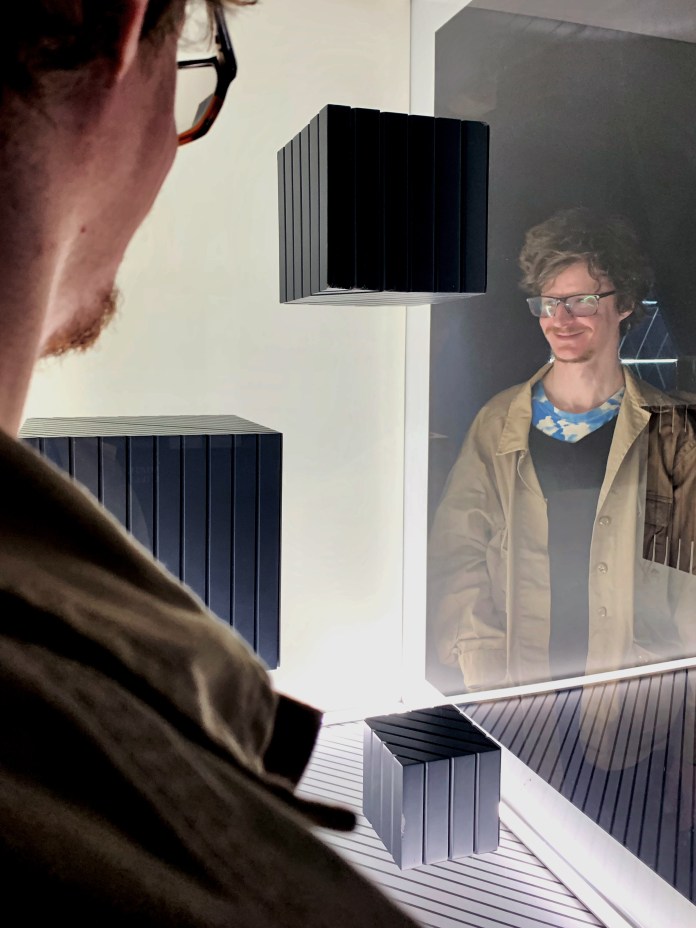
Jean Néant photographed at the Montreal Museum of Illusions by Louise Callier for NicheMTL

Standard
How Do You Spell Holiday?

Will It Float?: in conversation with Sarah Pagé

Sarah Pagé, the Montreal harpist, was not the fifth Beatle.

But she did play in the same room where The Beatles in 1964 nearly broke American television, at the Ed Sullivan Theatre on Broadway in New York City. And though they weren’t The Beatles, Pagé was essentially the third Barr Brother as a founder member of that influential indie folk band with whom she performed for more than a decade, landing upon the Sullivan stage as the musical guest on Late Show with David Letterman.

“I wasn’t counting on being very inspired by it,” Pagé tells me of the Letterman appearances — there were two, the second of which featured Bill Cosby’s last-minute replacement with Regis Philbin.

Pagé and I talk via Zoom between late-night Montreal and early-morning Japan; she is there for three months taking “serious, serious Koto lessons,” she tells me. For now, however, I’m less interested in those lessons. I want to know what it was like playing on Letterman’s legendary variety show, or as the host himself habitually quipped, “the only thing on CBS right now.”

“My imagination,” Pagé recalls, “doesn’t extend into the past and the future as much as some people’s. So even though I know it’s in the Ed Sullivan Theatre, and there’s all this history to it, and I’ve seen amazing performances from that stage for my entire life, I’m very much always like, I’m in a room. But actually, it was pretty surreal and incredible.”

Paul Shaffer, Letterman’s musical director, knew that their number would be in the key of C, and had the band play “Tomorrow Never Knows” in C during the commercial break “so that we could tune,” Pagé remembers. “And as soon as I stepped on the stage, hearing that band playing a Beatles song, I really felt it. It totally blew me away. I felt the Ed Sullivan Theatre thing. It was amazing.”

Sarah Pagé’s latest recording, Voda, the Russian word for water, is only her sophomore solo album. And yet it still became a collaborative effort of sorts — with the Russian/Ukrainian choreographer, Nika Stein.

Stein in 2014 invited Pagé to participate on a contemporary dance piece exploring themes of vitality and mortality by way of water. “It’s her concept, this whole album,” Pagé says.

“The central theme is water, but water is a metaphor for the cycles of life and death, and the workings and layers of the subconscious, and the depths of the mind. We talk a lot about how confrontational and uncomfortable it is to deal with any of that subject matter. And the difficulty is, it can’t be dealt with in a literal sense. It always has to be approached through metaphor and myth.”

Appropriately, Voda was made in the mountains about an hour north of Montreal, in a studio constructed just on the cusp of the pandemic. Pagé managed to escape the city as the most severe of the Covid lockdowns went into place, and spent that extended solitary time mastering the recording arts.

“There was something about the narrative content of Voda that I felt,” Pagé muses.

“It’s almost like doing a cinematic score for a movie that you’ve got in your head that nobody else has seen, and nobody else is going to see. It was a lot to take on, and I really didn’t plan on it ballooning into such a huge production.” Though a few co-conspirators did manage to sneak onto the album, Pagé composed, engineered, edited, and mixed the record herself.

She describes the experience as “really intense — the recording process is really the time where, like a painter, you get to look at the canvas and be super controlling about it. Like, I want this colour right here, and that light over there is getting in the way, so I’ll put a little bit of a darkness here.”

Pagé’s commitment to detail holds water on a subtle and emotional album that is an aesthetically pleasing but not always easy listen. Although its central theme is fluidity, Voda is decidedly an anti-streaming collection of works — a deliberate move, Pagé reveals, “because of the artistic context we’re living in today.”

Structurally and thematically, Voda resists the mass audience and music industry demands of pushing forth evermore watered-down content. “I think I’ve created an album that many people will either be completely interested in, or turned off by,” Pagé concedes. “And that’s fine.”

Part of her niche appeal is Pagé’s disregard for generic boundaries, a sensibility informed by an insatiable fascination with all sorts of music. A wunderkind classically trained pianist, Pagé loved to discover the odd clash of 1970s rock and classical music stashed in her family’s record collection: The Beatles, The Rolling Stones, Pink Floyd, Bob Dylan — and Bach.

“Definitely playing Bach was always a big thing for me,” Pagé recounts. “There’s something about the intricacy of the way he writes counterpoint, and arranges. Particularly his music for solo and single-voice instruments: cello, lute, violin. There’s something about the way he can develop a single melody and give it so much shape and direction and real drama and harmony, in rhythms that, at that time, were all pretty square and predictable. There’s just a real mastery of melody there that I’ve always really admired.”

“I think I’ve created an album that many people will either be completely interested in, or turned off by. And that’s fine.”

Pagé sensed early on that her life would be devoted to music-making. “I have pretty vivid memories of my first recital as a kid,” says Pagé.

“I can remember the feeling, which is one that I have often felt later in life, which is a bit juvenile to admit to, but I don’t mind. I think I wasn’t used to getting a lot of attention or having a lot of space as a kid, and I recognized in performance that the audience had no choice but to sit there until I was done. I take a lot of space. Sometimes I decide to repeat a whole section, or change the setlist, or stay on one thing for a really long time. Like being a kid, I’ll take a super overly long dramatic pause if I feel like it, if I need to get people’s attention in a different way.” Pagé realized right away that she could be the only show on the station.

Still, Pagé occupies the stage with poise, and shares it with grace. “I really feel that most of what I do is in the hopes that it reaches another musician and there’s a possibility to get into each other’s spaces,” she says.

Despite her reputation as a dream collaborator — with the likes of Stein, Esmerine, Joni Void, and the late Lhasa de Sela — Pagé seems to steal the spotlight wherever she goes. Even David Letterman couldn’t help but crack a joke in her direction as he bid the audience goodnight.

Always the gentlemen, Letterman wanted to ensure that Pagé didn’t have to schlep her harp on her own. “Did someone carry that into the studio for you?” Letterman demands. “If not, I’m calling the union!”◼︎

Voda is released via Backward Music.

Photos by Thomas Boucher & Jean Cousin.

Standard
Play Recent

Gather ‘round the piano

Francesco Fusaro, Clavicentrico (Self-Released)


It is not every day that someone names their album after something you invented.

To clarify, I did not invent ‘claviocentrism;’ but I did coin the term. It was in late 2012 — exactly ten years ago, come to think of it — as I was writing an article for the good folks at The Quietus, on the 30th anniversary of MIDI. I was struggling to find a word to describe how central, both culturally as well as physically, the piano had become to western music since the inception of the standard, black-and-white, ebony-and-ivory, together-in-perfect-harmony, clavier-style keyboard to which we are all so accustomed today. But there wasn’t one. Ergo, claviocentrism.

I received an email from one of tQ’s editors saying that he had Googled claviocentrism and it came back a Googlewhack — there were no prior instances of that word indexed in the search engine. I was embarrassed. I replied sheepishly admitting that I had indeed invented the term, and asked if they would like it changed. But the editor said absolutely not to change a single thing, that they were “chuffed” to publish a neologism, and that it was in fact a “cracking piece.” I still remember those words. A cracking piece!

When I perused the press release for Francesco Fusaro’s Clavicentrico, I had to do a double-take. Clavicentrico? It’s not a word I come across often, never, and I thought it might just be a mighty coincidence. But I scrolled down and noted a hefty quote pulled from my 2018 book, Mad Skills, and realized that my concept of claviocentrism had inspired Fusaro not only to compose a touching cycle of “non-virtuosic” piano music, but also to give Claviocentrism an Italian twist.

When you do things, especially when you do things out of desperation, you can never be sure what kind of impact those things will have. When you write a book, or make an album, or paint a picture, or dance a jig, you can never possibly imagine how that book or album or picture or jig will change the world. Probably it won’t. But maybe it will, and probably is not a reason to not try.

Black Ox Orkestar, Museum of Jewish Montreal, 14 December 2022

It is wonderful to have a piano in the kitchen. The kitchen is usually the room in the house where people spend most of their time, and tend to have the best times, over food and family, fellowship and fun. At every party, I always end up in the kitchen.

Pianos, though, are most often relegated far away to the music room or the study, or worse, they become just another piece of furniture in the living room, covered in framed family photos and all manner of other kitschy trinkets.

But the piano, if you are fortunate enough to possess one of these magical instruments in working order, should be kept, I believe, in the home’s most central location. So that anyone, at any time, can start to play it and immediately turn the moment musical.

Pale Ribbons Tossed into the Dark, Fable Guide, Pale Ribbons Tossed into the Dark (Self-released)

The social position of the flâneur was desirable in the 19th century, a person to emulate, the free-floating subject nonetheless un-subjected to the city’s confines of work and family, not institutionalized by institutions, nor hospitals, universities, corporations, prisons, or other such operational enclosures.

Today, the flâneur that is truly untethered from those enclosures is a terrible zombie wandering dazed and spreading capital virally through the confines of hyper-capitalism, a superstructural biodome surrounding the other operational structures that more traditionally enclosed and still enclose, separate, and subjugate subjects.

Even in domestic spaces and other private, seemingly “free” zones, more often the internet nowadays encloses us, and various platforms and subnetworks divide and subdivide that virtual enclosure into smaller and smaller virtual rooms that ultimately reveal our abject isolation in a post-industrial meatspace. Any collective being, even industrial, is no longer necessary.

The contemporary flâneur is either crazy or an exploitative object vis-à-vis subjectivity; that is, capital liberates their subjecthood, thus they subject others using capital in commercial and service environments to their flâneuristic whims. We are all always either working or making others work. There is no leisure today without exploitation. And the guilt, “onboarded” — to use a terrible bro-culture buzzword — from a Christian social order that no longer exists or applies or is even suitable to our quotidian realities still subliminally dictates that leisure is wasteful, sinful, even to a Godless economic society that only idolizes productivity.

La fête du clavecin Kirckman, Chapelle historique du Bon-Pasteur, 15 December 2022

One of the things I love about Montreal is that events like this take place: a concert of a 250-year-old harpsichord in an historic chapel, and it’s free. Were the proceedings entirely in French? Oui. And was I the youngest, Anglo-est person there? Oui encore. But did that matter? Mais non.

Halfway through the performance, however, I started imagining that, to audiences 250 years ago, a harpsichord might have seemed like cheating, like a facile way to emulate the virtuosity of a real harp. Harpsichords, although they utilize the same form of 12-tone keyboard as their piano cousins, are different instruments.

For instance, pianos strike their strings with hammers, meaning that the harder a player hits the key, the harder the hammer strikes the string, and the louder the note sounds. Harpsichords conversely pluck their strings with plectra, a piece of stiff leather similar to a guitar pick. So, when a note is played, the plectrum plucks the string with equal intensity regardless of how hard the player hits the key. This gives the instrument an unsettling on-off sound that we 21st century listeners are not accustomed to hearing. It is more like a music box absentmindedly clanging out a tune. The note is either sounding or silent. It is actually very binary, not unlike early MIDI.

MIDI, or the musical instrument digital interface, is a standard computer “language” that makes it possible for digital instruments of different manufacturers to communicate with one another. MIDI is what allows, say, one central sequencer to control an array of peripheral equipment like synthesizers, samplers, effects processors, mixing boards — even lights and smoke machines. In the digital music studio, it is impossible to overstate the importance of using one common language.

Sarah Pagé, Méduses, Voda (Backward Music)

What is the ultimate experience? What experience could you experience that would put an end to the longing for more experiences? How would you know it was the ultimate it?◼︎

@nichemtl

Standard