How Do You Spell Holiday?

All In The Family: in conversation with Kiva Stimac

Pre-Christian festivals traditionally marked the turning of the seasons, celebrating solstices, equinoxes, the planting and harvesting of crops, and other sundry natural cycles.

Festivals nowadays are largely symbolic of such seasonal celebrations, centering more upon common interests and activities like film, theatre, dance, and music.

The festivalization of cultural industries in the 21st century has meant that patrons more often than not expect a curated round-up of events rather than any stand-alone experience. There are such things today as “festival circuits,” a secondary calendar upon which cultural products and producers travel and tour year-round.

Without doubt, one of Montreal’s most interesting springtime festivals is Suoni per il Popolo, currently entering its 24th iteration.

Founded in 2000 by the artist, printmaker, and chef, Kiva Stimac, Suoni, for short, has become a much anticipated and lovingly lauded launch pad for those with big ears for experimental sounds.

“Montreal is at its most beautiful right now,” Stimac observes as we chat over the phone on a sunny late May morning. “And the festival this year — I’m very proud of. We made it so we’re going to have challenging, revolutionary, good times.”

“Montreal audiences are very enthusiastic.” Kiva Stimac for Popolo Press.

Stimac and Godspeed You! Black Emperor bassist Mauro Pezzente have collaborated since the festival’s inception on booking bands at Casa del Pololo and La Sala Rossa, twin venues that they started nearly a quarter century ago, which have become go-to stages for local and international musicians, and venerable institutions for Montreal’s music aficionados.

“We had a very deep love for music of all kinds,” Stimac says of the impetus behind Suoni’s founding. “But we noticed that bands were skipping Montreal. People would play Boston, Toronto, but they would skip Montreal. For instance, Arab Strap wasn’t playing Montreal. So, we booked them a show at Casa, and it sold out in 10 minutes.”

Originally called Artichaut, the venue that now houses Casa del Popolo in 2000 was “more like a hippie space,” Stimac remembers.

“At that time, this part of St. Laurent was very desolate, uninhabited,” recalls Stimac. “The rent was affordable enough that we signed a lease. And everybody started coming in while we were trying to renovate, trying to get our permits and stuff, saying, ‘hey, I was supposed to play a show here next week, or ‘I was supposed to do something here in a month from now.’ So, we just started saying ‘okay’ to people.”

Quickly, demand for these live happenings coalesced and Stimac realized that she could invite artists of her own choosing, renting the Spanish Cultural Center across the street soon afterward and transforming its upper level into La Sala Rossa.

“Montreal audiences are very enthusiastic,” Stimac notes. “From the first year of the festival, everybody that we called and asked to play said ‘yes.’ And to come and play an artist-run, small venue, not necessarily knowing us, once they showed up and it was a family vibe, and we cooked them food, and gave them advice on the sound, even though these were small spaces, with the vibe of the audiences, everybody was really enthusiastic.”

A singular aesthetic is Suoni’s hallmark, but the festival is recognized for curating artists from diverse genres — from punk to funk, classical to jazz — and across various demographics, too. It is not a youth-oriented or fashion-specific affair.

Some of this year’s highlights include No Hay Banda on June 13th performing a commissioned piece that Sarah Davachi composed; the Swedish vocalist and electronic composer Erika Angell on June 17th, and industrial-rap superstar Backxwash, aka Ashanti Mutinta, on June 21st.

“Having our final show be Anthony Braxton and Wolf Eyes is a pretty big deal,” Stimac remarks. “That’s the elder free-jazz experimenter hero, and then the noise-making trickster Detroiters, also heroes, coming together and making a sound that is really special.”

For the first time, day passes will also be sold this year for $45, allowing patrons to attend every event on any given day.

“Sometimes, it’s challenging,” Stimac admits, regarding programming Montreal’s premiere avant-garde festival. “A lot of times, it’s problematic. It’s not like, oh my God, we’ll play Kumbaya and everybody’s going to come together. Oftentimes it forces people apart or sets people into scenes, like ‘oh, I can’t interact with this or that scene.’ So, having multiple intergenerational interracial scenes here, that is very important to me.”

While the city’s bigger festivals like Osheaga, Pop Montreal, or the Jazz Fest court corporate sponsorship and attempt to attract higher-profile star power, Suoni deliberately remains committed to showcasing the best underground artists from Montreal and internationally. Stimac believes that a strong sense of community and solidarity through struggle is at the heart of Suoni’s ethos.

“We want to sell these shows, but also be true to who we are as people.” Kiva Stimac for Popolo Press.

“I didn’t create this thing as a business,” says Stimac, “or even as a festival. I created this as a family situation. Family isn’t just blood, either. It’s chosen family, too. The outsiders, the misfits, the queers, the punks — we’re all an international family. How do we exist in a world that’s so tragic and horrific?”

Stimac answers her own question: “I think making music and art of all kinds — dance, theatre, visual art — is an important connecting point to get to the next step of, hopefully, creating something different in this world.”

Montreal and music’s independent scenes have changed significantly since Stimac conceived of the festival. Covid and its restrictions were particularly difficult on the arts and one of Stimac’s performance venues, La Vitrola, was forced to close its doors.

The cost of mounting major events like Suoni increased three and four-fold as artists and their surrounding industries attempted to make up for lost revenues. Even though her festival has thrived for more than two decades, Stimac seems acutely aware of wanting to share the wealth as ethically as possible.

“When you’ve been around for 24 years, and you have some funding, a lot of times you’re also seen as ‘the man.’ We want to sell these shows, but also be true to who we are as people. That’s the hustle,” Stimac explains.

At twelve days, this edition of Suoni is leaner and more focussed than previous years, with fewer shows programmed against each other, leaving more room for audiences to discover the depth and diversity of Stimac’s vision. Still, she is generous to give credit where it’s due. From ancient fairs and feasts to modern festivals, the central theme of any seasonal celebration has always been a spirit of communion.

“I’m not looking to be the curator of the entire festival anymore,” says Stimac. “I’m doing this with over 25 different co-presenters from all different backgrounds. I just do what I can do with my own hands. So, I make the posters, I make the food, DIY. But hopefully we’re figuring out more how to DIT — do it together.”◼︎

The 24th edition of Suoni per il Popolo runs 12-23 June 2024.

Standard
How Do You Spell Holiday?

Use Your Illusion: in conversation with Joni Void

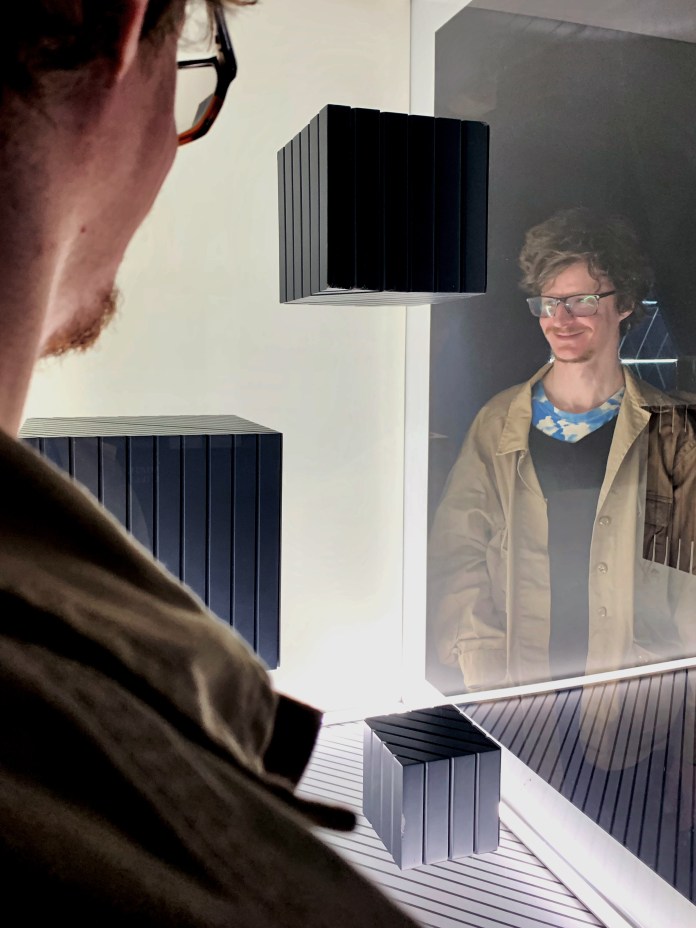
Jean Néant — who records and performs as Joni Void — and I have just received a guided tour of the Museum of Illusions, a new, social media meme-ready attraction in Old Montreal, and are sat now upon a park bench on Rue le Royer, the block-long pedestrian strip that serves as a sort of replica of somewhere in France.

It’s an abundance of touristic activity.

But it is not like France, Néant tells me, hailing from that country. It is no less spectacular. But it is very much like Montreal, the extraordinary international city that Néant chose as his creative home.

Montreal’s DIY scene drew Néant out from being a bedroom producer in the late aughts to performing solo onstage; releasing recordings via the revered Constellation Records label, the most recent of which is entitled Everyday Is The Song; collaborating with the likes of Mardi Spaghetti, the city’s improvised music series, and experimental harpist Sarah Pagé; and mounting his own events, first at the now-defunct loft space called La Plante, where Néant lived for two years, and since 2018 under the aegis Everyday Ago.

“When I was in France,” says Néant, “I was a bedroom producer never thinking I would play live. I thought there was no point because I was just on my laptop. The idea of being a part of a scene and a community for me was online. But moving to Montreal and going to the Plante and all these DIY venues and house shows, all these artists were just playing with computers onstage and it wasn’t an issue. The music was good and people were having a blast.”

Joni Void is performing a handful of live dates in Montreal before embarking on a tour of Japan in July. The trip was originally slated for 2020 but was cancelled, as Néant quips, “for reasons that might be apparent. So here we are, three years later.”

Following the fallout from the pandemic, Néant is looking forward to returning to Japan, where they toured in 2019. “I never had a trip that went so easy and smooth,” Néant says of that experience. “All the acts we played with were next-level. I’m very lucky.”

“I was a bedroom producer never thinking I would play live.” Louise Callier for NicheMTL

Néant became a resident at La Plante in 2015 and shortly thereafter met a group of likeminded people that formed around a love of avant-garde, experimental music. “I just kind of moved in,” says Néant, “and my friends put together a show that had Sarah Pagé and Markus Floats, who would later release on Constellation.”

It was at this event that Néant conceived of collaborating with Pagé as the duo known now as Page Vide. Néant and Pagé hit it off immediately — “especially” deadpans Néant, “when I helped her carry her harp down the narrow stairs of La Plante. Goddamn, that was a challenge. That was like foreshadowing. Like, wow I will be doing that a lot. That harp knows me now.”

Page Vide are currently working on their first album, Néant says, having finished three tracks, with six more in the works. The duo performs at Suoni per il popolo on June 23rd and at Mutek on August 27th. The autodidact Néant couldn’t be more of a foil for Pagé, a classically trained and supremely disciplined instrumentalist who visits Japan for months at a time for Koto lessons. “I’m as self-taught as you can be,” he proclaims.

Néant began making music in his mid-teens after discovering GarageBand on the family computer, and downloading the stems that more and more artists were making available to encourage engagement with their audience.

“My friends were making mashups,” Néant recalls. “Radiohead and Nine Inch Nails at the time were allowing their multitracks to be remixed. They had their songs online and you could just download the tracks and create your own remixes.”

This participatory activity actually encouraged an entire generation, including Néant, to turn their parents’ bureaucratic, number crunching machines into makeshift music studios.

Néant launched a project called Johnny Ripper, sampling, distorting, and reconstructing snippets of popular songs into psychedelic sonic collage existing somewhere between Girl Talk and Tim Hecker’s Radio Amor. Johnny Ripper caught the ear of Constellation, which encouraged him to derive less and produce more: “I do have a singular style but it acknowledges its sources.”

“I call my music ‘cinema-tek / camera-tronica’ which is not a genre but a way of explaining that I make cinematic electronic music.” Louise Callier for NicheMTL

Néant confesses that he endured an identity crisis and found inspiration in the work of Delia Derbyshire, diving deeply into her music and interviews.

“It’s all this magnetic tape that she would cut up and pitch all these things that you do with a click now on a computer,” says Néant. “To feel like that’s the way she was thinking of sound and music and all that is the way I make music. I make music like I would use a camera, basically. I call my music ‘cinema-tek / camera-tronica’ which is not a genre but a way of explaining that I make cinematic electronic music. It’s made through an intense editing process.”

Everyday Is The Song reveals a montage-like structure — as does Néant’s discussion, jump cutting at times across subjects that seem unrelated but eventually come around. We talk about Néant’s love of optical illusions, “Mise en abyme” being the title of Joni Void’s 2019 album. We talk about how the pandemic reshaped Montreal’s more niche scenes and their slow but steady return. “I’m seeing more events with ‘DM for address,’” Néant notes. “I don’t want to be like ‘nature is healing,’ but there’s definitely a new circuit that is forming.”

It is a beautiful late spring day and a chorus of birds nestles into a nearby bush, twittering up a cacophony of bright birdsong. “My favourite birds are crows,” Néant suddenly declares.

“There’s a park in Japan where there’s a shitload of crows and I always figured I would go one day with a lot of coins, and a lot of food, just be friends with all the crows in the park, and if ever I have issues in life, I’d just have my army of crows.”◼︎

Everyday Is The Song is released via Constellation Records

Jean Néant photographed at the Montreal Museum of Illusions by Louise Callier for NicheMTL

Standard
999 Words

The Real Thing: in conversation with No Hay Banda

“There is no band.”

I walk myself into this obligatorily cheeky response, I suppose, when I ask the three core members of No Hay Banda — the Montreal contemporary music collective / band / events organizer / community builder — if they are a band, or what.

Violinist Geneviève Liboiron, pianist Daniel Áñez, and percussionist Noam Bierstone operate under the mysterious Lynchian moniker as a contemporary classical power trio that’s more art than any one facet of it. As the name suggests, they keep their operations deliberately vague.

“There are fine lines all over the place,” Áñez tells me at the group’s rehearsal studio near the D’Iberville metro, which also functions as an artist’s residence for travelling musicians. “What is contemporary? What is experimental? What is musical theatre? What is electronic? We have not yet put lines, but we’re inside those genres.”

No Hay Banda began in 2016 as a concert series held at La Sala Rossa, the landmark Plateau neighbourhood venue that serves as the collective’s exhibition space, and lends the proceedings its red-curtain vibe.

Since, the cooperative has dabbled in expanded performance; founded a record label called No Hay Discos, upon which they released their own impressive double-album debut; and are now producing a two-night show at the Chapelle de La Cité-des-Hospitalières, the historic chapel attached to Hôtel-Dieu, premiering an opera entitled Body Without Organs (With Organ) by the acclaimed Japanese experimental vocalist Tomomi Adachi. “He’s incredible,” Liboiron says.

Throughout the pandemic, No Hay Banda, along with vocalist Sarah Albu and guitarist An Laurence, recorded a serial opera by Adachi called 51 Short Pieces for Soprano, Violin, and Guitar, releasing one video daily online.

“Some of them are like five seconds,” Liboiron says, “super theatrical, super short, one or two notes.” The project carried the trio through the depths of quarantine, and also forged an enduring relationship with Adachi that brings him to Montreal for a 10-day residency and various performances affiliated with the Suoni per il popolo festival.

“Adachi asked us if he could write us his second opera,” says Bierstone. “So it’s a semi AI-created opera. A lot of the text is AI-generated, but I don’t think any of the music is.”

“How would we know?” jests Áñez.

Each of the two performances features different local openers, encouraging audiences to return for round two. On June 16th, the harpist Sarah Pagé plays an electronically manipulated Koto against percussionist Patrick Graham. On June 17th, the duo of Chloë Lum and Yannick Desranleau celebrate the release of their new album, The Garden of a Former House Turned Museum, on the No Hay Discos imprint.

“We’re super happy to have them in our label,” Áñez says. “All of our shows have two artists, two sets. Like a local set and an international set. No Hay Banda has ambitions to be a place of exchange that has eyes inside and also has eyes outside.”

The trio often talk in nebulous ambiguities like this, and it reminds me of the way the niche American filmmaker David Lynch discusses his work — obliquely and in metaphors. “We love David Lynch,” says Liboiron.

The name No Hay Banda is borrowed from the striking scene in Lynch’s Mulholland Drive in which the protagonists attend a surreal theatrical performance that is one part Vaudeville, one part acid trip.

“We started all the concerts with that scene from the movie,” Liboiron explains. “People are just having drinks, listening to the music, and when this would start, it was the cue that the show was about to begin. And also we are producers that are sometimes playing. So in all the dimensions of the scene, David Lynch was matching our aesthetic, we felt.”

“It’s come up more,” adds Bierstone, “in situations we didn’t expect. Like this Adachi piece: there is a lot of lip syncing and faking and playing with the public’s perception. We don’t pick pieces because they are very David Lynch, but it just happens.”

Áñez elaborates: “We also found somewhat of a manifesto in this idea. Because the text says, ‘There is no band, il n’y a pas un orchestre, it’s all a tape recording.’ And then there’s all these performers on stage in that scene in the movie where they’re faking that they’re playing and then they show that they’re not playing. It’s all part of that concept of alternative performance that we try to bring into our concert series. We are not blinded by it. Like, sometimes we have concerts where there is just a pianist playing the piano. But there’s this idea of a new way of playing and presenting yourself.”

No Hay Banda is insistently blazing fresh tracks in the Montreal contemporary experimental music scene, and slowly, steadily creating a new constellation of affiliates.

“I would say it’s been very hard since the pandemic to bring the public back to the halls,” Liboiron concedes. “Even before, it’s always been really hard for doing contemporary experimental music, to have a huge public. But we know there are a lot of people in Montreal and around that would love to see these shows. It would be really nice to meet all of them.”

“We’re pursuing this artistic path of alternative performance, so we touch the public that goes to experimental theatre. And we touch the public that goes to experimental dance. The shows that No Hay Banda puts together rejoin this wider public that is interested in fucked-up-edness,” says Áñez.

In that specificity, something universal emerges out of No Hay Banda’s creative project, which is augmented by their perplexing air of obscurity. Like a David Lynch movie, there are no simple explanations for what these or any artists do, no Hollywood endings that wrap up the plot.

“Leaving things open and vague allows us to develop in ways we would have been too restricted to had we said we were just a concert series,” Bierstone says.

What to expect from their Adachi collaboration?

“It’s hard to know,” teases Liboiron, “what it is going to be.”◼︎

Tomomi Adachi & No Hay Banda perform 16 & 17 June 2023 at Chapelle de La Cité-des-Hospitalières.

Cover image: Noam Bierstone photographed by Robert Del Tredici.

Standard