How Do You Spell Holiday?

Holiday in Another Country: notes on mass cultural amnesia

The only time I was fortunate enough to teach a class at McGill, I asked my students during one particular lecture — all 97 of them — who had heard of Jean-Michel Basquiat. No one raised their hand.

To put it mildly, I was astonished. This was 2014. And here was a group of third-year students in their early 20s that, I assumed, all had functioning Wi-Fi connections and social media accounts, and were all more or less hip. Hipper than I was, I believed, because they were younger.

This was an incorrect assumption. I thought that just because they had the internet, they knew everything. But they knew next to nothing. Correction: they increasingly knew solely what the internet served.

It was only a decade ago, before Basquiat’s work enjoyed a rapid renaissance thanks to name checks in Jay-Z tracks, international museum tours, high-profile scandals, and colossal fugazis. Before algorithms generally set the agenda for cultural production. Before A.I. forgot more than we’ll ever know.

Specifically, here was a demographic of early 20-somethings who in a relatively short span of time went from possessing no knowledge of Jean-Michel Basquiat to possessing widespread knowledge of Jean-Michel Basquiat. Yet it wasn’t that long ago either, only a few decades, that Basquiat was alive and well-known amongst his own generation of 20-somethings.

Basquiat is a fairly niche example for cultural connaissance, to be sure. But instances of amnesia are elsewhere, too, making it something of a ubiquitous niche phenomenon.

Take as a second example Kate Bush. Another group of 20-somethings had recently never heard of Kate Bush — unless their weird parents listened to Lionheart — before they were suddenly bombarded with Kate Bush due to her music’s appearance in the Netflix series, Stranger Things.

These giant gaps and new bridges across recent culture remind me of Jerry Seinfeld’s 90s era joke about CD boxed sets: “Well, I don’t own anything by Steely Dan, but now I’d like to own everything by Steely Dan.”

Anecdotally, I have noticed that young people today — read, kids in their 20s — generally tend to have two types of knowledge: deep, or none at all. They know everything there is to know about their thing, and nothing about anything else.

It’s a fandom-twinged knowledge, clearly identifying tribes to their members — the Kate Bush tribe; the Basquiat tribe; the Steely Dan tribe. People are either in or out, on or off, a curious condition for a supposedly post-binary generation.

During a recent conversation with one of these [young people,] I asked whether [this person] had ever seen Cheers, among the most successful television shows in broadcast television history. To which [this person] replied, “I’ve seen clips of it.” [Hint: internet.]

Later in our conversation, I mentioned the film A Clockwork Orange. Again, I received a blank stare, which stunned me. How had [this person] lived 25 years in the postmodern world and never even heard of one of the most iconic texts of 20th century cinema? [Hint: internet.] It’s fitting that the latest social network is called “Threads,” because we’re losing them, fast.

The novelty of recent history displacing distant history might not seem like a big deal. But cumulatively, it translates into a new generation having a very limited understanding of the generation immediately preceding it. Not in modern history has there been such a lack of continuity between cultural vernaculars from one generation to the next.

Surely, this will cascade.

In her 2004 book, Dark Age Ahead, the cultural theorist Jane Jacobs warned of a void of knowledge emerging in the Western world. This, Jacobs argued, was due to the dissolution of family and community; higher education’s turn towards credentialization; the corporatization of the sciences; the corruption of national governments; and the disconnection with cultural history.

Poetically, Jacobs calls endemic forgetfulness the “fifth demonic Horseman” of the apocalypse. She writes: “During a Dark Age, the mass amnesia of survivors becomes permanent and profound. The previous way of life slides into an abyss of forgetfulness, almost as decisively as if it had never existed.”

The Dark Age we refer to as The Dark Age, following the fall of the Roman Empire, took place about 1000 years ago. Also about 1000 years ago, Eastern Orthodoxy emerged in what was called The Great Schism — the movement of Christianity further away from Rome. Is knowledge truly being forgotten? Or is it just venturing a little farther down the road?

The question as we move through this era of mass forgetfulness is, what knowledge to preserve? What made our culture great? Was it agriculture, textiles, masonry, geography, alchemy? Our most recent iteration of culture prized entertainment as its greatest resource.

This is not simply a gripe about contemporary culture being worse off than its precedents, like the old axiom in the 90s that the 60s was a more creatively rich decade. That too. Taylor Swift is no Emmylou Harris, and there isn’t even an historical equivalent of something like Nicki Minaj.

This is something else entirely. The “kids these days” aren’t into crap recent history either, as the antecedent era might have been fascinated with ironically inspired interests — kitsch, say, or Steely Dan.

Though, wherever there’s crisis, opportunity knocks. There is space for exposing young minds to artifacts like Cheers and Stanley Kubrick’s masterpieces, and probably many more relics that today’s youth have never heard of, but should have by now. There could be Recent History classes taught in universities that survey the quickly forgotten rather than just the faraway past.

Spanish philosopher George Santayana said, ‘Those who cannot remember the past are condemned to repeat it.’ Who needs to relive the 90s again, again? Wouldn’t it be better if today’s youth had a casual awareness of Perry Farrell as much as Kurt Cobain? If they knew Tony Danza like they do Ross from Friends?

I would be pleased to teach such a class. Let’s call it Holiday in Another Country, since that’s what the past is. It seems further away than ever now.◼︎

Standard
How Do You Spell Holiday?

Use Your Illusion: in conversation with Joni Void

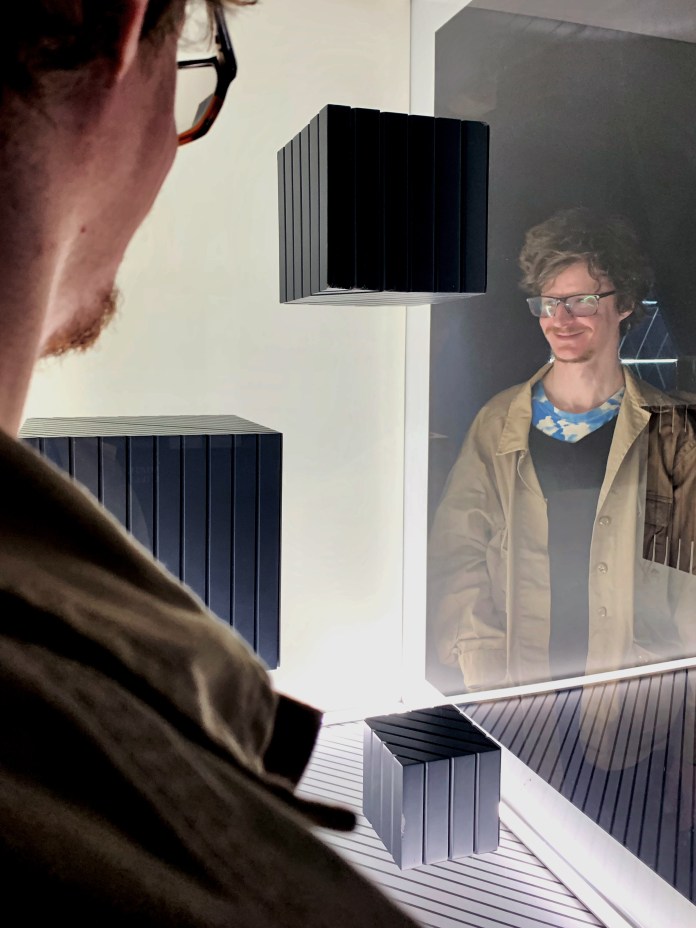
Jean Néant — who records and performs as Joni Void — and I have just received a guided tour of the Museum of Illusions, a new, social media meme-ready attraction in Old Montreal, and are sat now upon a park bench on Rue le Royer, the block-long pedestrian strip that serves as a sort of replica of somewhere in France.

It’s an abundance of touristic activity.

But it is not like France, Néant tells me, hailing from that country. It is no less spectacular. But it is very much like Montreal, the extraordinary international city that Néant chose as his creative home.

Montreal’s DIY scene drew Néant out from being a bedroom producer in the late aughts to performing solo onstage; releasing recordings via the revered Constellation Records label, the most recent of which is entitled Everyday Is The Song; collaborating with the likes of Mardi Spaghetti, the city’s improvised music series, and experimental harpist Sarah Pagé; and mounting his own events, first at the now-defunct loft space called La Plante, where Néant lived for two years, and since 2018 under the aegis Everyday Ago.

“When I was in France,” says Néant, “I was a bedroom producer never thinking I would play live. I thought there was no point because I was just on my laptop. The idea of being a part of a scene and a community for me was online. But moving to Montreal and going to the Plante and all these DIY venues and house shows, all these artists were just playing with computers onstage and it wasn’t an issue. The music was good and people were having a blast.”

Joni Void is performing a handful of live dates in Montreal before embarking on a tour of Japan in July. The trip was originally slated for 2020 but was cancelled, as Néant quips, “for reasons that might be apparent. So here we are, three years later.”

Following the fallout from the pandemic, Néant is looking forward to returning to Japan, where they toured in 2019. “I never had a trip that went so easy and smooth,” Néant says of that experience. “All the acts we played with were next-level. I’m very lucky.”

“I was a bedroom producer never thinking I would play live.” Louise Callier for NicheMTL

Néant became a resident at La Plante in 2015 and shortly thereafter met a group of likeminded people that formed around a love of avant-garde, experimental music. “I just kind of moved in,” says Néant, “and my friends put together a show that had Sarah Pagé and Markus Floats, who would later release on Constellation.”

It was at this event that Néant conceived of collaborating with Pagé as the duo known now as Page Vide. Néant and Pagé hit it off immediately — “especially” deadpans Néant, “when I helped her carry her harp down the narrow stairs of La Plante. Goddamn, that was a challenge. That was like foreshadowing. Like, wow I will be doing that a lot. That harp knows me now.”

Page Vide are currently working on their first album, Néant says, having finished three tracks, with six more in the works. The duo performs at Suoni per il popolo on June 23rd and at Mutek on August 27th. The autodidact Néant couldn’t be more of a foil for Pagé, a classically trained and supremely disciplined instrumentalist who visits Japan for months at a time for Koto lessons. “I’m as self-taught as you can be,” he proclaims.

Néant began making music in his mid-teens after discovering GarageBand on the family computer, and downloading the stems that more and more artists were making available to encourage engagement with their audience.

“My friends were making mashups,” Néant recalls. “Radiohead and Nine Inch Nails at the time were allowing their multitracks to be remixed. They had their songs online and you could just download the tracks and create your own remixes.”

This participatory activity actually encouraged an entire generation, including Néant, to turn their parents’ bureaucratic, number crunching machines into makeshift music studios.

Néant launched a project called Johnny Ripper, sampling, distorting, and reconstructing snippets of popular songs into psychedelic sonic collage existing somewhere between Girl Talk and Tim Hecker’s Radio Amor. Johnny Ripper caught the ear of Constellation, which encouraged him to derive less and produce more: “I do have a singular style but it acknowledges its sources.”

“I call my music ‘cinema-tek / camera-tronica’ which is not a genre but a way of explaining that I make cinematic electronic music.” Louise Callier for NicheMTL

Néant confesses that he endured an identity crisis and found inspiration in the work of Delia Derbyshire, diving deeply into her music and interviews.

“It’s all this magnetic tape that she would cut up and pitch all these things that you do with a click now on a computer,” says Néant. “To feel like that’s the way she was thinking of sound and music and all that is the way I make music. I make music like I would use a camera, basically. I call my music ‘cinema-tek / camera-tronica’ which is not a genre but a way of explaining that I make cinematic electronic music. It’s made through an intense editing process.”

Everyday Is The Song reveals a montage-like structure — as does Néant’s discussion, jump cutting at times across subjects that seem unrelated but eventually come around. We talk about Néant’s love of optical illusions, “Mise en abyme” being the title of Joni Void’s 2019 album. We talk about how the pandemic reshaped Montreal’s more niche scenes and their slow but steady return. “I’m seeing more events with ‘DM for address,’” Néant notes. “I don’t want to be like ‘nature is healing,’ but there’s definitely a new circuit that is forming.”

It is a beautiful late spring day and a chorus of birds nestles into a nearby bush, twittering up a cacophony of bright birdsong. “My favourite birds are crows,” Néant suddenly declares.

“There’s a park in Japan where there’s a shitload of crows and I always figured I would go one day with a lot of coins, and a lot of food, just be friends with all the crows in the park, and if ever I have issues in life, I’d just have my army of crows.”◼︎

Everyday Is The Song is released via Constellation Records

Jean Néant photographed at the Montreal Museum of Illusions by Louise Callier for NicheMTL

Standard
How Do You Spell Holiday?

Will It Float?: in conversation with Sarah Pagé

Sarah Pagé, the Montreal harpist, was not the fifth Beatle.

But she did play in the same room where The Beatles in 1964 nearly broke American television, at the Ed Sullivan Theatre on Broadway in New York City. And though they weren’t The Beatles, Pagé was essentially the third Barr Brother as a founder member of that influential indie folk band with whom she performed for more than a decade, landing upon the Sullivan stage as the musical guest on Late Show with David Letterman.

“I wasn’t counting on being very inspired by it,” Pagé tells me of the Letterman appearances — there were two, the second of which featured Bill Cosby’s last-minute replacement with Regis Philbin.

Pagé and I talk via Zoom between late-night Montreal and early-morning Japan; she is there for three months taking “serious, serious Koto lessons,” she tells me. For now, however, I’m less interested in those lessons. I want to know what it was like playing on Letterman’s legendary variety show, or as the host himself habitually quipped, “the only thing on CBS right now.”

“My imagination,” Pagé recalls, “doesn’t extend into the past and the future as much as some people’s. So even though I know it’s in the Ed Sullivan Theatre, and there’s all this history to it, and I’ve seen amazing performances from that stage for my entire life, I’m very much always like, I’m in a room. But actually, it was pretty surreal and incredible.”

Paul Shaffer, Letterman’s musical director, knew that their number would be in the key of C, and had the band play “Tomorrow Never Knows” in C during the commercial break “so that we could tune,” Pagé remembers. “And as soon as I stepped on the stage, hearing that band playing a Beatles song, I really felt it. It totally blew me away. I felt the Ed Sullivan Theatre thing. It was amazing.”

Sarah Pagé’s latest recording, Voda, the Russian word for water, is only her sophomore solo album. And yet it still became a collaborative effort of sorts — with the Russian/Ukrainian choreographer, Nika Stein.

Stein in 2014 invited Pagé to participate on a contemporary dance piece exploring themes of vitality and mortality by way of water. “It’s her concept, this whole album,” Pagé says.

“The central theme is water, but water is a metaphor for the cycles of life and death, and the workings and layers of the subconscious, and the depths of the mind. We talk a lot about how confrontational and uncomfortable it is to deal with any of that subject matter. And the difficulty is, it can’t be dealt with in a literal sense. It always has to be approached through metaphor and myth.”

Appropriately, Voda was made in the mountains about an hour north of Montreal, in a studio constructed just on the cusp of the pandemic. Pagé managed to escape the city as the most severe of the Covid lockdowns went into place, and spent that extended solitary time mastering the recording arts.

“There was something about the narrative content of Voda that I felt,” Pagé muses.

“It’s almost like doing a cinematic score for a movie that you’ve got in your head that nobody else has seen, and nobody else is going to see. It was a lot to take on, and I really didn’t plan on it ballooning into such a huge production.” Though a few co-conspirators did manage to sneak onto the album, Pagé composed, engineered, edited, and mixed the record herself.

She describes the experience as “really intense — the recording process is really the time where, like a painter, you get to look at the canvas and be super controlling about it. Like, I want this colour right here, and that light over there is getting in the way, so I’ll put a little bit of a darkness here.”

Pagé’s commitment to detail holds water on a subtle and emotional album that is an aesthetically pleasing but not always easy listen. Although its central theme is fluidity, Voda is decidedly an anti-streaming collection of works — a deliberate move, Pagé reveals, “because of the artistic context we’re living in today.”

Structurally and thematically, Voda resists the mass audience and music industry demands of pushing forth evermore watered-down content. “I think I’ve created an album that many people will either be completely interested in, or turned off by,” Pagé concedes. “And that’s fine.”

Part of her niche appeal is Pagé’s disregard for generic boundaries, a sensibility informed by an insatiable fascination with all sorts of music. A wunderkind classically trained pianist, Pagé loved to discover the odd clash of 1970s rock and classical music stashed in her family’s record collection: The Beatles, The Rolling Stones, Pink Floyd, Bob Dylan — and Bach.

“Definitely playing Bach was always a big thing for me,” Pagé recounts. “There’s something about the intricacy of the way he writes counterpoint, and arranges. Particularly his music for solo and single-voice instruments: cello, lute, violin. There’s something about the way he can develop a single melody and give it so much shape and direction and real drama and harmony, in rhythms that, at that time, were all pretty square and predictable. There’s just a real mastery of melody there that I’ve always really admired.”

“I think I’ve created an album that many people will either be completely interested in, or turned off by. And that’s fine.”

Pagé sensed early on that her life would be devoted to music-making. “I have pretty vivid memories of my first recital as a kid,” says Pagé.

“I can remember the feeling, which is one that I have often felt later in life, which is a bit juvenile to admit to, but I don’t mind. I think I wasn’t used to getting a lot of attention or having a lot of space as a kid, and I recognized in performance that the audience had no choice but to sit there until I was done. I take a lot of space. Sometimes I decide to repeat a whole section, or change the setlist, or stay on one thing for a really long time. Like being a kid, I’ll take a super overly long dramatic pause if I feel like it, if I need to get people’s attention in a different way.” Pagé realized right away that she could be the only show on the station.

Still, Pagé occupies the stage with poise, and shares it with grace. “I really feel that most of what I do is in the hopes that it reaches another musician and there’s a possibility to get into each other’s spaces,” she says.

Despite her reputation as a dream collaborator — with the likes of Stein, Esmerine, Joni Void, and the late Lhasa de Sela — Pagé seems to steal the spotlight wherever she goes. Even David Letterman couldn’t help but crack a joke in her direction as he bid the audience goodnight.

Always the gentlemen, Letterman wanted to ensure that Pagé didn’t have to schlep her harp on her own. “Did someone carry that into the studio for you?” Letterman demands. “If not, I’m calling the union!”◼︎

Voda is released via Backward Music.

Photos by Thomas Boucher & Jean Cousin.

Standard
How Do You Spell Holiday?

Enfant de Bohème: in conversation with Michel Beaulac

The Opera de Montreal’s venerable veteran Artistic Director, Michel Beaulac, has travelled the world and visited some of its most notable concert halls — Palais Garnier, La Scala, Teatro Comunale di Bologna among them. But his roots as a music lover are planted firmly in the working-class neighbourhood of Pointe-Saint-Charles.

“I like that section of Montreal. I have a lot of memories there,” says Beaulac on a phone call during the final weekend before five performances (another was added, by popular demand, on May 16th) of Puccini’s Madama Butterfly close out the company’s 43rd season. “Butterfly is certainly an opera that is always sold out because there is a connection there with the audience. People think it really is about a Geisha in Nagasaki, and her tragic story. But it really is so much more. It’s a denunciation of Imperialism. It’s a denunciation of power.”

Beaulac comes from a financially modest family. “In Pointe-Saint-Charles, that was really the rule,” he says. “Everybody was, not poor, but of relatively meagre means.”

When he was five, Beaulac’s favourite uncle, an Ear, Nose, and Throat specialist at Notre-Dame Hospital, who happened to be the preferred referral for touring singers performing in the city, gifted the family a phonograph and a few classical recordings. “The only records we had in the house were those my uncle had given us,” Beaulac recalls. “One was Casse-Noisette. And the others were Werther, and Carmen, with Raoul Jobin, which Raoul Jobin had given him because he had just seen him for throat problems.” Particularly, Carmen first caught Beaulac’s ear — and broke his heart.

“I used to sing the words,” Beaulac remembers, “not really understanding the story. And when Carmen died at the end, I would run over to my mother, because I had a cousin whose name was Carmen. I would always go to my mother and say, ‘Carmen is dead!’ And my mother would have to tell me, ‘no, this is just a story, Carmen is not dead. Your cousin Carmen is not dead.’”

By his mid-teens, Beaulac began attending performances that the Orchestre Symphonique de Montreal co-produced, featuring singers like Shirley Verrett and Richard Verreault. And at 18, he saved up enough money working summer jobs to visit Europe’s most storied opera houses.

“That was just such an incredible experience,” Beaulac recollects. “I was still developing that fascination for the voice and for opera and I never thought I’d spend my life in opera. I never really hoped or even thought of it.”

Beaulac’s career took a roundabout path. He taught for ten years, and then studied sculpture and painting, before landing a job in communications at Opera de Montreal. “And that’s where it all started,” Beaulac laughs. “It was such luck. I mean, I began in communications and moved on. I had a good knowledge of space, and structure, and drawing, and colours. One day a set designer dropped out. The director at the time said, ‘we have a production in seven months and the designer just dropped out, do you want to do the sets?’ And I never say no, so I jumped in.”

Since, Beaulac has served as the OdM’s Artistic Director and shows no signs of slowing down. The company is already casting for its 2024-’25 season. “We’re starting to look ahead,” Beaulac says with genuine excitement. “We’re really starting to plan who I could have here in ‘25-‘26. It’s really rolling.”

As other high artforms like cinema, prestige TV, and video games seem to be losing their post-covid appeal amongst younger audiences, opera is gaining a new generation of aficionados. With the OdM’s world premiere of La Beauté du Monde, the composer Julien Bilodeau’s collaboration with Quebec dramaturg Michel Marc Bouchard, and Juno winner Keiko Devaux’s debut at the Darling Foundry in January of L’ecoute du Perdu, Montreal is emerging as the new world leader in a centuries-long tradition.

“Opera hasn’t just survived,” Beaulac affirms, “it has developed. Opera has become this formidable artform that is so complete — that brings art, and architecture, and music, and words, and drama, and dance, and movement. This is what is so fascinating about this artform, and why you and I are so taken by it. It’s a world unto itself. When I hear people in the tech world talk about the metaverse, I think that we had access to the metaverse before they did.”

In efforts to attract younger audiences, the OdM has experimented in recent years with opening up dress rehearsals to the public, showcasing performances in a more informal setting. Still, Beaulac finds that people are drawn to opera’s immersive, transformative potential, regardless of age.

“It’s kind of a magnet,” Beaulac explains. “Opera is an artform that we can express thoughts and feelings that are connected to today’s reality. New works do that. The audience, young and old, wants to be told stories. People love to be told a story. Especially if the music is carrying it. Time slows down. They get to that meditative state where they get into the story. When it’s well put together, and the artists are really communicative, and the story is presented to them beforehand so that they already have a grasp of what they’re going to see, or if they get to look it up on their phones, they love it.”

Just don’t ask Beaulac to select a favourite. “There are so many,” he says, “for different reasons. In the 15 years I have been here, even where I’ve got to pick and choose, there are still too many.”

Beaulac is especially proud, though, of his contributions to the 2014 staging of Porgy and Bess. “We got to work nine months with Trevor Payne,” says Beaulac, “who’s an incredible musician and artist, an incredible person, an incredible soul. We worked with the Montreal Gospel Choir, and that was a real community. And the consciousness of the Black community in Montreal, and the connection that the Montreal Opera forged with the Black community, it was one of the most riveting and fulfilling experiences. It was incredible.”

Beaulac is equally fond of his relationship with Yannick Nézet-Séguin. “We did several operas together,” Beaulac says of the Montreal native who is currently Conductor of the Metropolitan Opera Orchestra in New York City. “I gave him his first Bohème,” Beaulac beams, “his first Butterfly, his first Cosi Fan Tutti.” In 2018, Nézet-Séguin returned to lead a co-production with the Orchestre Metropolitain in a triumphant concert version of Beethoven’s only opera, the rarely performed and mythically regarded Fidelio. “Those are fond memories, Beaulac recalls. “Yannick is a great musician.”

When it comes to contemporary artists, Beaulac is most drawn to the classics, listing off The Beatles, Roberta Flack, and Aretha Franklin, before mentioning George Michael as a recent inspiration. I note that Michael is among the 2023 Rock & Roll Hall of Fame inductees. “George Michael was phenomenal,” Beaulac approves. “He was very talented. He wrote beautiful music.”

Nonetheless, opera is the be-all and end-all for Beaulac. “I was literally brought up with opera,” a history pressed on albums made right across the canal at the RCA plant in Saint Henri, and spinning out on a gramophone likely manufactured just down the street at the Northern Electric factory in the Pointe.

“Pointe-Saint-Charles is very dear to me,” Beaulac says nostalgically. “Whenever I take my car out, I always go there, like on a pilgrimage. I see where I lived when I was a kid, and see the river, and Boulevard LaSalle. It’s always very moving to see that for me.◼︎

Madama Butterfly continues May 9th, 11th, 14th, and 16th at Salle Wilfrid-Pelletier.

photo: Brent Calis

Standard
How Do You Spell Holiday?

Another Brick in the Wall, Pt. 2: notes on the Berlin Wall segment

In the spring of 1987, US president Ronald Reagan delivered an address — one which has since accrued exponential renown — against the backdrop of the Berlin Wall, that old dividing line between East and West, communism and capitalism, totalitarianism and democracy.

The Berlin Wall physically represented what was more broadly called the “Iron Curtain,” the ideological veil separating opposing ways of seeing and ways of life. At that time, history was bending towards us in the West, with our free-market economies and liberal-leaning societies seemingly leading the way. Reagan famously demanded of the Soviet ruler: “Mr. Gorbachev, tear down this wall.”

Here in the West, we believed in individualism and freedom, which supposedly supported a democratic and responsible government and fostered economic competition and innovation. The Soviet satellite republics enjoyed nothing of the sort, living under dreary planned economies, deprived of private property, with collective standards outstripping human rights, and a resigned sense of political corruption and impending doom destined to pervade daily life.

The Berlin Wall signified this. And at first glance, it seems that the segment housed in the Centre de commerce mondial’s atrium is evidence. The West side is spraypainted with graffiti and splashed with bursts of vibrant colour; the East side is bleak and bears only what appear to be administrative markings. Obviously, the permissive West was the superior flank, and we assumed simply that freedom would naturally flow eastward with the wall’s dissolution in 1990.

But that hasn’t happened.

What we call democracy was intended to guarantee that governments were responsible to the people who elected them. And yet the world’s two leading democracies, the United States and Britain, have demonstrated that even free choice doesn’t assure the contentment of the demos.

The way democracies are structured in the West ensures the perpetual tyranny of the minority. In the US, the population is more-or-less divided, but in the UK, as in Canada, ruling parties can routinely form a “majority” government with 30% or less of the vote. The UK has endured an undemocratic transfer of power so many times in the past decade that it’s difficult to count. And more than 40% of Americans still don’t trust the 2020 presidential election outcome. Maybe it’s time to admit that this form of democracy we live under has a few flaws.

Communications technologies were meant to liberate us Westerners, freeing everyone from the shackles of space and time and allowing the unfettered flow of information to permeate borders and broaden hearts and minds.

And yet the West’s media are constantly warring with each other over what constitutes important information, and who holds the truth. Elon Musk, Twitter’s new owner, has such contempt for the media that he has replaced his company’s entire public relations department with an auto-reply message delivering a poop emoji.

Before the fall of the Berlin Wall, state surveillance of private individuals was considered one of the most heinous transgressions of Eastern totalitarianism. The Oscar-winning 2006 film The Lives of Others depicted the humdrum occupation of an East German surveillance officer assigned to spy on the conversation and communication of ordinary citizens. This cinematic rendering was supposed to look shocking to Western audiences, a revelation of how low totalitarian governments stooped just to collect a little bit of information.

And yet we in the West have shrugged at exposé after exposé of major media corporations — and governments, too — conducting mass-surveillance that would make Stasi Hauptmann Gerd Wiesler blush like a nun. Social media like Facebook and Twitter are arguably little more than surveillance networks.

Ultimately, it was concluded to be capitalism, like the pudding’s eating, that would prove the West’s dominance. Open competition in every marketplace would allow everyone, doing anything, the opportunity to succeed, for cheaper, thus providing the best possible goods and services to a free public for the least cost, freeing up more capital for leisure and the pursuit of happiness.

And yet the world’s capitalist economies since 1990 have heaved through at least three recessions — one of them “great” — a financial crisis in 2008 precipitated by the collapse of major lending institutions, and the unprecedented consolidation of wealth into the fewest hands in history. A recent Oxfam report found that the 1 percent, as we have come to accept them, snatched nearly two-thirds of all new wealth created since 2020. At $42 trillion, that’s almost twice as much as the bottom 99 percent of us.

What do you buy when you can afford anything? Ironically, the most coveted bauble in the free West is Control.

Capitalism undermines democracy when it becomes possible to purchase political power. And unrestricted communication is compromised when the channels are owned and operated by capitalists for the purposes of surveillance. The free marketplace ceases to be free when capital stomps out competition. And ultimately, the demos — us citizens — lose trust in the system.

That’s what the East-West divide always seemed to be about: trust. If you want for nothing, you can trust your neighbour. You can trust the free media. You can trust the best products. You can trust the most popular politicians. And you can trust fair elections.

Except, as we all know, we can trust none of these things.

Again, it is ironic that the East appears to have won in the trust department, too. You can’t trust Biden or Trudeau or whomever happens to be Britain’s Prime Minister at the time of writing. But you can trust Putin to be Putin. That’s why Trump won — and may again: because, no matter how ridiculous his tactics, America could always trust Trump to Trump.

Our free and liberal democracy has afforded, among other things, what appears to be free and fair choice in all walks of life, including governing authorities, consumer products, and channels of communication. Western life gives us in Montreal the freedom to display a segment of the Berlin Wall as if it’s the spoils of some brutal war in some distant past, as if to say, “job done.” But the job isn’t done. Walls just like it and worse are still being built. And the once shining triptych of democracy, technology, and capitalism has lost its lustre.

On the 25th anniversary of the fall of the Berlin Wall, Mikhail Gorbachev warned the world of a new Cold War emerging between East and West, one rooted in the Ukrainian question, and aggravated by what Gorbachev referred to as American “triumphalism.” The West got cocky is what Gorby meant. Instead of ensuring that another wall like it could never happen again, we just decorated it.

First as tragedy, then as tourist attraction.◼︎

Standard
How Do You Spell Holiday?

Cheap Essential Scenery: seven ideas to fix Montreal’s short-term rentals

There are no innocent bystanders … what are they doing there in the first place?

―William S. Burroughs, Exterminator!

I wanna see some history
‘Cause now I got a reasonable economy.

—Sex Pistols, “Holidays in the Sun”

In the wake of the devastating fire that tragically cut short seven lives, destroyed an historic Old Montreal edifice, and shattered the entire community, everyone was quick to point fingers, all away from themselves.

The media blamed the owner for allowing the building to violate a multitude of codes, including hosting short-term rentals, which became illegal in 2018 in the Ville-Marie borough. The mayor blamed Airbnb, who was listing the accommodations despite their prohibition. In efforts to appease the city, which has already displayed hostility towards Uber and Lime, Airbnb vowed to crack down on unlicensed listings, something they should have been doing in the first place.

Still, no one has blamed the obvious offenders: the tourists themselves. Because if there were no demand for illegal accommodations, and nobody willing to stay in them — haven’t you seen that video? — landlords wouldn’t find evermore reprehensible ways to list their slummy properties illegally, and Airbnb wouldn’t have to crack down on them. And maybe seven people would still be alive.

Nobody ever said that those travellers should have taken responsibility for themselves; should have checked to see if their Airbnb listings had certification numbers; should have checked to see if their accommodations had important things like windows or escape routes; should have questioned why their stays in Old Montreal were so cheap. In order to save money, each of these people deliberately did not take a hotel, and they unfortunately paid the ultimate price.

This is the most cold-hearted niche take yet. But the upshot is that everyone is to blame for this cascading disaster: the landlord for listing illegal short-term rentals in an unsafe building; Airbnb for not double-checking their listings; the city for not enforcing our bylaws; travellers for their reckless disregard; and the community as a whole for allowing this building to exist in such a dangerous state. This fire reveals a deficiency in Montreal’s tourism industry: with nine million visitors expected to make Montreal their destination this summer, we need better, safer, more affordable places to stay.

CultMTL called for the all-out ban on Airbnb’s, but that is unrealistic and the city has already signalled that they are satisfied with Airbnb’s response. The extra tourism that Airbnb attracts is too lucrative to turn away. This likely means Airbnb’s and their particular sort of budget travellers are here to stay, at least for now. Yet there are seven things that Montreal could do to create the kind of accommodations that keep travellers comfortable and safe — and in turn, could render Airbnb obsolete.

The first is to diligently hold Airbnb to its commitments. If the company vows to crack down on unlicensed listings, follow up and make sure that they do. When asked point-blank why the city isn’t shutting down illegal Airbnb’s, the Executive Committee Vice Chairperson for the Commission de l’habitation et de la cohésion sociale of the Communauté métropolitaine and Sud-Ouest borough mayor, Benoit Dorais, offered three words: “It’s really difficult.” No. It’s really easy. All the city — or anyone — has to do is search on Airbnb. Every listing that is not located near Saint-Catherine Street between St. Mathieu and Amhurst is illegal.

Number two: encourage an Airbnb alternative. Montreal is home to some of the world’s most talented tech workers. With so many job cuts in that industry over the past year, there must be an abundance of idle hands just waiting to code the next made-in-Montreal app capable of doing what Airbnb does, but better. Montreal created the Bixi program and not only does it make Lime scooters and Jump bikes unnecessary, it has become the global bikeshare model.

Third: make it understood in buildings known for illegal rentals that they are not allowed. I live in an Old Montreal apartment that has frequently hosted illicit Airbnb’s. Our residents, with the assistance of the condo board and management company, have fought hard to ensure that they are not welcome this summer, installing a sign in the lobby and charging fines for violators.

Number four: equip bylaw enforcement with better tools to find offenders. If Airbnb skirts the bylaws by obscuring the addresses of accommodations, pass a bylaw that makes it necessary to disclose those addresses. No hotel would ever attempt to hide its geographical location. So why should Airbnb? Uprooting illegal listings and keeping guests safe is more important than the privacy of a few Airbnb property owners.

Five: convert disused city properties into mixed-use short-term accommodations and regular rentals. The city could lease or acquire office space that has gone vacant since Covid and remodel those buildings into living spaces for the city’s travellers and residents who need it most. With the recent announcement of the remodelled Eaton Centre restaurant, it is clear that these sorts of retrofits are a popular idea.

Six: license Casa Particular-type B&B accommodations in which travellers can stay with people willing to open up their homes. That would encourage responsibility from hosts and guests alike and relieve the city of some of the supervisory burden over companies like Airbnb. This manner of tourism is popular in Cuba, for example, and offers an authentic local experience for both budget travellers as well as owners monetizing their properties. Montrealers serve as the best ambassadors to Montreal.

Seven: as seasons change and news cycles move on, let us not forget this fire’s victims. Let us remember Dr. An Wu, 31; Dania Zafar, 31; Saniya Khan, 31; Nathan Sears, 35; Charlie Lacroix, 18; Walid Belkahla, 18; and Camille Maheux, 76. Maheux was a resident of the building for over three decades and did not deserve to have her life end this way. None of these people did.

If lawsuits arise against Airbnb, they should see trial and not be settled out of court. Settlements prevent the justice system from administering justice. By design, they also keep these incidents out of the public eye. Usually accompanied by some form of non-disclosure agreement, out-of-court settlements limit what victims are allowed to do and say. More often, the defendant accepts no guilt or responsibility. So when it comes time for cities to regulate, Airbnb can honestly claim that they were never technically found guilty or responsible for terrible things, even though they plainly paid their way out of admitting guilt or accepting responsibility for terrible things. Airbnb has a long history of buying itself out of calamities. Don’t let them.

On Friday, March 24th, on a neighbourhood walk after a long week, I took a cup of tea and headed down St. Paul. I found myself standing on the corner from which the building’s skeleton was still visible. It was a bright, crisp afternoon, not quite springtime, not yet tourist season, but almost. I thought of all the excited visitors Montreal will be welcoming this summer. And I thought that their vacations will sadly take place in this tragedy’s long shadow. The site was still marked out with danger tape and an SPVM officer was busy returning to his patrol car. As he approached, I saw tears in his eyes, because not all cops are bastards, but all capitalists are.

Louis-Philippe Lacroix, father of Charlie Lacroix, one of the 18-year-olds killed in the fire, stoically said: “This happened, there’s nothing we can do, now do everything you freaking can to avoid another story like that.”

There are a few freaking things Montreal can do.◼︎

Report an illegal tourist home to the Ville de Montreal through this portal.

Standard
How Do You Spell Holiday?

Meet Your Maker: notes on (not) drinking bourbon

There is an old joke about two buddies, Frank and Jim, who go out for after-work libations.

Frank proceeds to get blind drunk and vomits all over his own shirt. He laments that his wife will be infuriated when she sees him in such a state. Jim, being a generous and ingenious pal, tells Frank to tell his wife instead that it was Jim who got bombed and barfed on Frank’s shirt. To corroborate this story, Jim instructs Frank to plant $10 into his shirt pocket, from Jim, to pay for the estimated dry cleaning.

The last drink of alcohol I ever had was Maker’s Mark bourbon. To be pedantic, the last drink of alcohol I ever had was an entire bottle of Maker’s Mark bourbon. It all started with one shot. Then another. Then another. I was at home, alone, and you would think that you can’t get into trouble drinking at home alone. But no.

I vaguely remember that the police arrived, then departed. More bourbon shots followed, which I do not recall. Yadda Yadda Yadda, and I found the bottle upside down in the sink the next morning. Of course I’m Yadda-ing over the worst part.

I don’t know why I was drinking. Perhaps it was the extreme loneliness of the pandemic. Perhaps it was the frustration around the extreme loneliness of the pandemic. Somehow the pandemic had something to do with it. But if I’m being honest, the pandemic was just another excuse, an easy target, like the solution to a 1930s social problem film. The real motive was the spirit in the bottle.

The reason they call spirits ‘spirits’ is because there is a powerful spiritual essence in there. It can take any form, any gender, any identity — it is fluid, after all. The spirit can be charming, clever, courageous, affectionate, amorous. But the spirit can also become impetuous, angry, even violent. And there is a point at which the spirit in the bottle can and will completely take over the spirit in the human being. The spirit assumes one hundred percent control, leaving behind nothing resembling that person, and the spirit will do whatever it will. Fundamentally, its will and our will are out of sync. No one ever says, ‘I’m glad I did X while drunk.’

I am not absolving myself of any responsibility here. It was I who invited the spirit into my life in the first place. I’m the one who drank the bourbon. And I drank everything that I ever drank leading up to the bourbon. But once that particular bourbon entered my bloodstream, I knew to whom its mark belonged. It was not the bourbon’s distiller; the “Maker’s Mark” was of the alcohol’s apposite creator. You know, that guy, from south of the border. (Hell, not America.)

I was invited earlier this month to an exclusive event at the brand new Hyatt Centric hotel in Old Montreal. A pre-Christmas tour of the facility was announced, and abruptly cancelled, for media personnel ostensibly covering the travel industry for various publications. I emailed the Hyatt to find out if the tour had been rescheduled and discovered that there was indeed a visit that very night, if I’d hustled to the property, followed by a tasting of a batch of Maker’s Mark bourbon produced especially for The Burgundy Lion’s sister restaurant, Cartier Arms. I was under the impression that journalism was dying. But it’s encouraging to see how many people consider themselves journalists when someone is administering journalists free bourbon shots.

The Hyatt Centric, the majestic, off-kilter, white cube that looms high on the horizon over Montreal’s most historically rich neighbourhood, seemed a fitting venue for the Maker’s Mark unveiling. Because of its architecturally anomalous design, its hallways appear to veer sideways. It is undeniably an admirably built edifice. But there is something Death Star-ish about it. Maybe it’s the fact that it is perpetually under construction. Or maybe it’s the fact that this Hyatt represents another giant corporation planting its flag in the heart of Montreal, thus marking yet another slide down the world’s slippery slope of ultimately toxic inclinations.

Toby Lyle, the restaurateur, and the aptly named Lindsay Wood, Maker’s Mark’s diplomat, were on hand to give their respective spiels describing this niche bourbon blend, called Adrianna, after Lyle’s daughter. They regaled the audience with details about how the bourbon is made, about how Maker’s Mark distillery boasts its own water source, about how bourbon needn’t be manufactured in Kentucky, but has to be blended using a minimum of fifty-one percent corn to be considered bourbon proper. Lyle divulged to the crowd that he’d planned to gift his daughter a bottle of her bourbon on her eighteenth birthday. I hope Adrianna respects the spirit that is now her namesake. I pray she understands the potential curse bottled therein.

A number of recent studies have concluded that, contrary to popular belief, there is no healthy amount of alcohol for humans. Nada. Zero. Zilch. All of the positive effects previously associated with booze — decreased blood pressure, antioxidation — can be better achieved with many other safe and effective methods that do not involve intoxication. We might have normalized alcoholism in modern society, but statistics suggest that young people are consuming far less alcohol than previous generations, and soft drink industry efforts to entice young consumers back to habitual boozing by introducing alcohol are both indicative of those trends, as well as proof of capitalism’s pure evil.

So, what was the worst part of my last drink?

When Frank arrives home, his wife is predictably enraged and immediately rebukes him. Frank, though, proceeds to unravel the alibi concocted earlier — that it was really Jim who had drunkenly vomited on Frank’s shirt. Frank implores his wife to check inside his pocket in which she will find $10, from Jim, for the dry cleaning. She inspects his pockets, but instead finds $20. To which Frank replies, “Well, he took a shit in my pants, too.”◼︎

Help is available if you or anyone you know is suffering from addictions.

Imbibe Adrianna exclusively at Cartier Arms, where there is also a selection of delicious virgin cocktails.

Standard